Hinduism & Sanatana Dharma
A Brief Sanskrit Glossary
A Spiritual Student’s Guide to Essential Sanskrit Terms

Sanskrit spiritual literature often assumes that the reader already understands a vocabulary that has no precise equivalent in English. Terms such as dharma, sadhana, vairagya, samadhi, prana, atman, Brahman, samskara, and moksha can carry layers of meaning that are easily lost in a simple one-word translation.
A Brief Sanskrit Glossary was created to help spiritual students cross that gap.
In this enlarged second edition, Swami Nirmalananda Giri provides translations and concise explanations for hundreds of Sanskrit terms commonly encountered in the Bhagavad Gita, the Upanishads, Patanjali’s Yoga Sutras, Vedanta, Hindu philosophy, and writings on yoga and spiritual practice.
The glossary goes beyond simple dictionary definitions. Many entries explain the philosophical or yogic significance of a term, distinguish related meanings, identify important scriptures and teachers, and provide the context needed to understand how a Sanskrit word is actually used in spiritual literature.
Readers of teachers such as Swami Sivananda will find the book especially useful, since traditional Indian spiritual writings frequently employ Sanskrit terminology without stopping to explain it.
This is not a Sanskrit grammar or pronunciation guide, and it does not use the full system of scholarly diacritical marks. It is instead what its subtitle promises: a practical spiritual student’s guide to the vocabulary of India’s scriptures, philosophy, yoga, and spiritual traditions.
Keep it nearby while reading. When an unfamiliar Sanskrit word appears, this compact reference can often turn a puzzling sentence into a much clearer teaching.
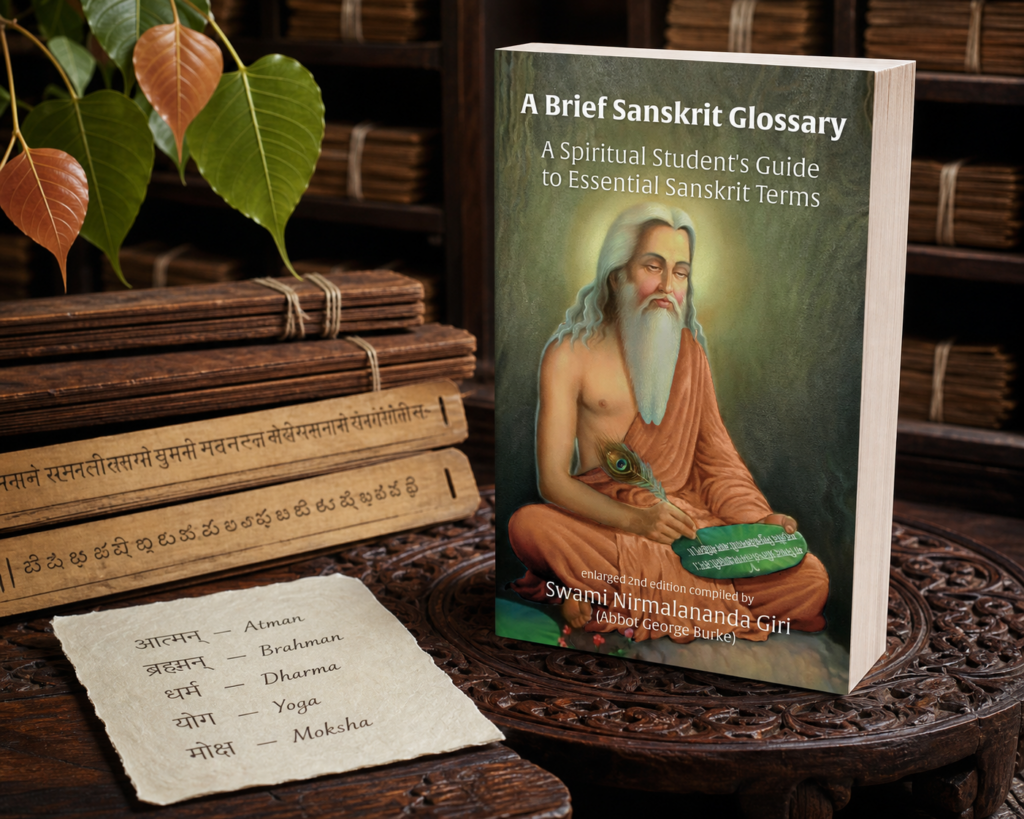
A book to live with
Why Read This Book?
Understand the language of Yoga and Vedanta — Gain practical definitions of Sanskrit terms frequently encountered in the Bhagavad Gita, Upanishads, Yoga Sutras, Vedanta, and other spiritual writings.
Go beyond one-word translations — Many Sanskrit concepts cannot be adequately rendered by a single English word. The glossary gives fuller explanations and related meanings that make the original concepts easier to understand.
Read traditional teachers with greater ease — Especially useful for writings that retain untranslated Sanskrit terminology, including the works of Swami Sivananda and other Indian spiritual teachers.
Keep a practical reference at hand — Designed for use while reading and studying rather than as a Sanskrit grammar or academic linguistic textbook.

Experience the writing
From the Book
Reference entry · Atman
The Self
Atma(n): The individual spirit or Self that is one with Brahman. The true nature or identity.
Atma-darshan: The seeing or sight of the Self (atma); the vision of the Self; knowledge of the Self through direct vision or knowing; the vision of seeing everything as the Self.
Atmajnana: Direct knowledge of the Self; Brahma-Jnana.
Atmasakshatkara: “Direct sight of the Self;” realization of the true nature of the Self; Self-realization.
Reference entry · SadhanaSpiritual Practice+
Sadhana: Spiritual practice.
Sadhana-chatushtaya: The fourfold aids to spiritual practice: 1) Viveka, the ability to discriminate between the transient and the eternal (nitya-anity-astu-viveka); 2) Vairagya, the absence of desire for securing pleasure or pain either here or elsewhere (iha-anutra-artha-phala-vairagya); 3) Shad-Sampat (The Sixfold Virtue): Sama, the serenity or tranquillity of mind which is brought about through the eradication of desires; Dama, the rational control of the senses; Uparati, satiety or resolutely turning the mind away from desire for sensual enjoyment; Titiksha, the power of endurance (an aspirant should patiently bear the pairs of opposites such as heat and cold, pleasure and pain, etc.; Shraddha, intense faith, lasting, perfect and unshakable; Samadhana, fixing the mind on Brahman or the Self, without allowing it to run towards objects; 4) Mumukshutwa, the intense desire for liberation.
Reference entry · MokshaLiberation+
Moksha: Release; liberation; the term is particularly applied to the liberation from the bondage of karma and the wheel of birth and death; Absolute Experience.
Continue the journey
Continue Exploring
Companion books and approved resources for going further.