Meditation & Yoga
Soham Yoga
An In-Depth Guide to Effective Meditation

Ordinarily our awareness is drawn outward toward objects, sensations, thoughts, and experiences. In that outward movement we lose sight of the Self—the pure consciousness that is our essential being. Meditation reverses this dispersion, turning awareness back toward its own source.
Soham Yoga presents a direct method for doing so. Soham means “I Am That” and is understood as the natural vibration of the Self, spontaneously associated with the breath. In practice, So is inwardly intoned with inhalation and Ham—pronounced approximately “Hum”—with exhalation, while awareness becomes increasingly absorbed in the mantra and the quiet movement of breathing.
The method is simple; the spiritual understanding behind it is deep. Swami Nirmalananda Giri explains why Soham is used, how breath and sound affect consciousness, the relation of the individual Self to the Supreme Self, and the foundations necessary for successful yoga. He also addresses practical obstacles, the natural deepening of meditation, and the ways Soham can continue beyond formal practice into daily life.
This teaching is not presented as a personal invention. The book places Soham within the Nath Yogi tradition and draws upon the testimony of Ramana Maharshi, Swami Sivananda, Sri Gajanana Maharaj, Swami Muktananda, Kabir, Shankara, and other saints and yogis who illuminate the inner path.
Throughout, the emphasis remains practical. The reader is not asked merely to understand Soham Yoga, but to practice it and discover its value through direct experience. The technique requires no needless complication; its essential demand is perseverance.
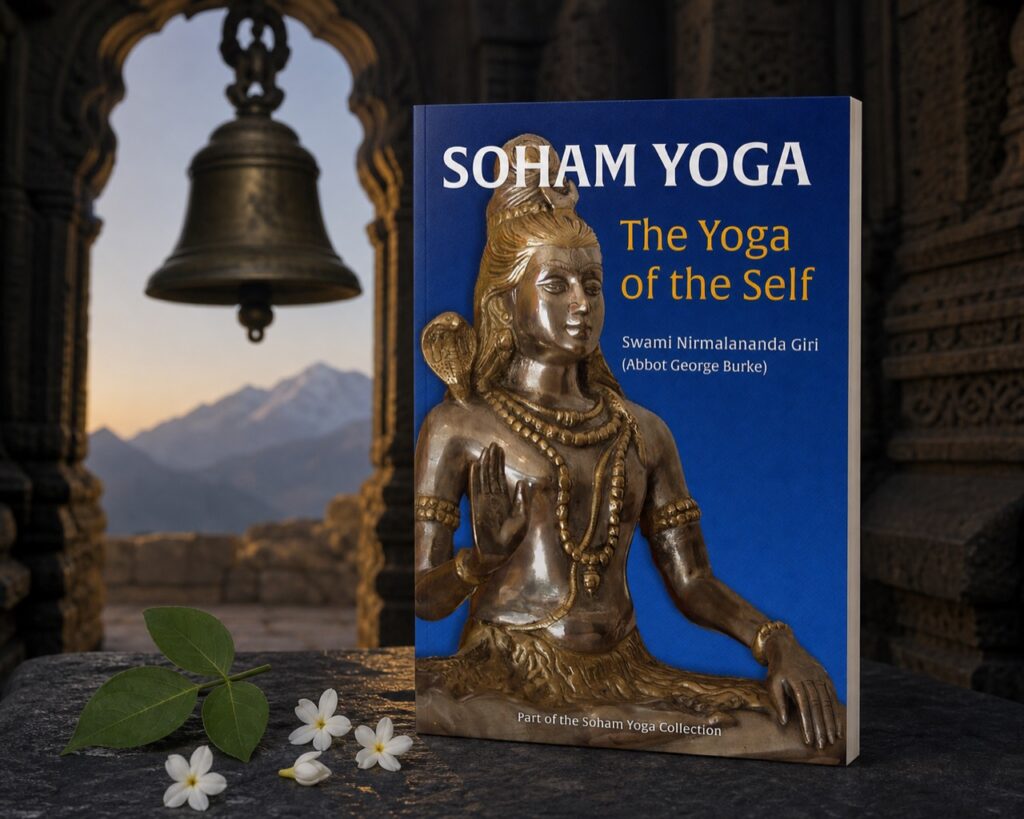
A book to live with
Why Read This Book?
Learn a clear, straightforward meditation practice centered on Soham—“I Am That”—and the natural breath.
Understand why Soham is used, not merely how to repeat it, through the book’s exploration of consciousness, mantra, breath, and the Self.
Receive practical guidance for establishing and deepening meditation without unnecessary complexity, elaborate ritual, or dependence on esoteric techniques.
Explore teachings from yogis and spiritual masters who place Soham and the inner path within a living spiritual tradition.

Experience the writing
From the Book
Featured excerpt
I Am That—the Natural Vibration of the Self
Soham (which is pronounced like “Sohum”) means: I Am That. It is the natural vibration of the Self, which occurs spontaneously with each incoming and outgoing breath. Through becoming aware of it on the conscious level by mentally repeating it in time with the breath (So when inhaling and Ham when exhaling), a yogi experiences the identity between his individual Self and the Supreme Self.
There are mantras that change things and others that reveal the eternal nature of things. Soham does both. According to the Nath Yogis (see Philosophy of Gorakhnath by Askhaya Kumar Banerjea), Soham has existed within the depths of God from eternity; and the same is true of every sentient being. Soham, then, will reveal our inner being. By meditating on Soham we discover our Self, within which Soham has existed forever.
The simple intonation of Soham in time with the breath (see Chapter Two) will do everything in the unfolding of the yogi’s spiritual consciousness. For sound and breath are the totality of Soham sadhana. (See Appendix Three: Breath and Sound in Meditation.)
The practice is very simple, and the results very profound. Truly wondrous is the fact that Soham Yoga can go on all the time, not just during meditation, if we apply ourselves to it. The whole life can become a continuous stream of liberating sadhana.
“By the mantra ‘Soham’ separate the jivatman from the Paramatman and locate the jivatman in the heart” (Devi Bhagavatam 11.8.15). When we repeat Soham in time with the breath we are invoking our eternal being. This is why we need only listen to our inner mental intonations of Soham in time with the breath which itself is Soham.
It is my hope that through practice you will experience for yourself the value and benefits of Soham Yoga that is presented in this book. The important thing about Soham Yoga is that it really works. It only takes perseverance. Archimedes said: “Give me a fulcrum and I will move the world.” Soham Yoga is the fulcrum.
Excerpt twoReversing Consciousness+
Meditation is the process of centering our awareness in the principle of pure consciousness within which is our essential being. As the Gita says: “He whose happiness is within, whose delight is within, whose illumination is within: that yogi, identical in being with Brahman, attains Brahmanirvana” (Bhagavad Gita 5:24).
Normally we lose awareness of our true Self through consciousness of external objects. Since we are habituated–if not actually addicted–to objective consciousness, we can use that very condition to our advantage. Rather than disperse our consciousness through objects that draw us outward, away from the source of our being, we can take an object that will have the opposite effect, present it to the mind, and reverse our consciousness.
Such an object must have three qualities: (1) it must be something whose nature it is to turn our awareness inward and draw it into the most subtle depths of our being, (2) it must be something that can continue to be perceived even in those most subtle areas of our awareness, (3) it must already be present in our inmost being awaiting our discovery of it. Therefore it must be an object that can both impel and draw us, accompanying our questing consciousness inward, not being transcended when the mind and senses are gone beyond, but revealing itself as the Self.
That object is the mantra Soham. By sitting with closed eyes and letting the mind become easefully absorbed in experiencing the inner mental repetitions of Soham in time with the breath, we thereby directly enter into the state of consciousness that is Soham, the state of consciousness that is both Brahman the Absolute and our Self. What takes time is becoming permanently and absolutely established in that consciousness.
Excerpt threeThe Practice in Its Simplicity+
1) Sit upright, comfortable and relaxed, with your hands on your knees or thighs or resting, one on the other, in your lap.
2) Turn your eyes slightly downward and close them gently. This removes visual distractions and reduces your brain-wave activity by about seventy-five percent, thus helping to calm the mind. During meditation your eyes may move upward and downward naturally of their own accord. This is as it should be when it happens spontaneously. But start out with them turned slightly downward without any strain.
3) Be aware of your breath naturally (automatically) flowing in and out. Your mouth should be closed so that all breathing is done through the nose. This also aids in quieting the mind. Though your mouth is closed, the jaw muscles should be relaxed so the upper and lower teeth are not clenched or touching one another, but parted. Breathe naturally, spontaneously. Your breathing should always be easeful and natural, not deliberate or artificial.
4) Then in a very quiet and gentle manner begin mentally intoning Soham in time with your breathing. (Remember: Soham is pronounced like our English words So and Hum.)
Intone Soooooo, prolonging a single intonation throughout each inhalation, and Huuummm, prolonging a single intonation throughout each exhalation, “singing” the syllables on a single note.
There is no need to pull or push the mind. Let your relaxed attention sink into and get absorbed in the mental sound of your inner intonings of Soham.
Fit the intonations to the breath–not the breath to the intonations. If the breath is short, then the intonation should be short. If the breath is long, then the intonation should be long. It does not matter if the inhalations and exhalations are not of equal length. Whatever is natural and spontaneous is what is right.
Your intonation of Soooooo should begin when your inhalation begins, and Huuummm should begin when your exhalation begins. In this way your intonations should be virtually continuous, that is: SooooooHuuummmSooooooHuuummmSooooooHuuummmSooooooHuuummm. Do not torture yourself about this–basically continuous is good enough.
5) For the rest of your meditation time keep on intoning Soham in time with your breath, calmly listening to the mental sound.
Continue the journey
Continue Exploring
Companion books and approved resources for going further.