Meditation & Yoga
Living the Yoga Life
Perspectives on Yoga

Living the Yoga Life is not primarily a manual of meditation technique. It is a book about the larger life that makes authentic practice possible: an entire way of thought, discipline, relationship, and inward orientation directed toward liberation of the spirit.
Arranged as a broad collection of reflections, the book looks beneath familiar language about yoga to examine what its principles require in experience. Swami Nirmalananda Giri considers the Atman and Brahman, bhakti and jnana, karma and reincarnation, mantra and breath, meditation and samadhi, the subtle anatomy, spiritual teachers, and the practical qualities of a yogi.
Throughout, he resists easy slogans and secondhand certainty. Drawing on a lifetime of practice, study, monastic life, and encounters with spiritual teachers, he asks readers to distinguish philosophy from realization, inspiration from transformation, and impressive claims from the steady evidence of an inwardly changed life.
The book therefore moves freely between metaphysical understanding and concrete counsel. It addresses independence, spiritual reading, discipline of mind and senses, the environment needed for practice, the discernment of true and false masters, and the perseverance by which meditation becomes a living center rather than an isolated activity.
Newer seekers can use these essays to understand the landscape of the yoga life, while experienced practitioners will find a candid companion for reflection and self-examination. The recurring invitation is to dive beneath the surface and bring every part of life into harmony with the quest for Self-realization.

A book to live with
Why Read This Book?
See why yoga must become an entire way of life, not a technique practiced in isolation.
Explore the Self, Brahman, karma, meditation, liberation, subtle anatomy, and other essential yogic principles.
Develop discernment about spiritual experience, teachers, habits, and the conditions that support real growth.
Receive practical counsel for turning philosophy into steady practice, inward awareness, and lived transformation.

Experience the writing
From the Book
From the Book
An Entire Way of Life
This is a compilation of random thoughts I put down quite some time ago that were completely without any order. Unlike Satsang With the Abbot, it is now somewhat arranged according to subjects. I hope it will be useful to those who read it.
This is not a book about the technique of yoga, but about the Yoga Life which makes the successful practice of yoga possible. Yoga is not just a practice or a philosophy; it is an entire way of life. And by yoga I mean the quest for liberation of the spirit, for Yoga is an eternal science intended to reveal and manifest the Eternal.
Consider a tree. The bark is not the tree; the leaves are not the tree; the branches are not the tree; nor are the roots the tree. But taken all together, that is a tree. If a single one of these elements is missing, then the tree will die. It is the same with yoga: nothing can be missing.
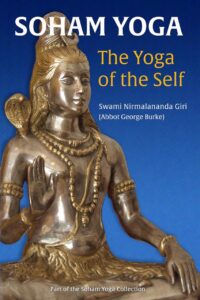
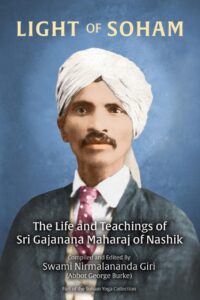
In various places mention is made of Soham Yoga. I recommend that you consult my books, Soham Yoga: The Yoga of the Self and Light of Soham.
Abbot George Burke
(Swami Nirmalananda Giri)
From the BookThe Real Life Is Interior+
There are two kinds of people: those who are in the world and those in whom the world is contained. The second are those who have internalized their experience of the world and “digested” it. They always look within, because the inward look alone will reveal the truth of things since that is where the Self dwells in union with the Supreme Self, God. Therefore in a prophetic description of the Virgin Mary, David (who later was born as Jesus) wrote: “The king’s daughter is all glorious within” (Psalms 45:13), because she was a perfected “interior soul,” having for lifetimes lived and evolved completely within in the kingdom of God.
Since we are a point of consciousness in the Ocean of Consciousness that is Brahman, we naturally think that we must look outward and move out of ourself to encounter God. But it is the opposite. We must increasingly turn inward, because God is the very core of our existence. The Bhagavad Gita speaks of Brahman as “seated in the heart of all” (13:17), and the Self as “seated in the body” (13:32), and “abiding in the heart of all beings” (10:20). Therefore the yogi must be habitually in-turned.
The yogi comes to know that the real life is interior and hidden by the exterior. Just as the shell hides the nut, so the physical body hides the antahkarana, the inner mechanism that really keeps the yogi alive.
Life in this world is a tapestry of tides or cycles: ebb and flow, rising and falling. And these movements are to be found in some extent even in the life of the yogi. Not that the yogi is unstable, but change is in the nature of things. Therefore we should be ever vigilant regarding our interior life and development and ready to immediately apply that which we know will increase and stabilize our basic state of consciousness.
From the BookPractice, Right Thinking, and Perseverance+
In yoga, practice combined with right thinking and living is everything.
It is the matter of perseverance that usually presents the greatest difficulty to the meditator. It is essential in yoga, as in ordinary matters, to realize that all goes according to precise laws. Wishing, wanting, hoping, praying, believing–or their opposites–have no effect at all. When speaking of meditation, Patanjali says: “Its application is by stages” (Yoga Sutras 3:6). That is, meditation keeps moving onward in its effect when regularly practiced, just like the taking of a journey. It all goes in an exact sequence. Therefore we cannot expect that meditation will produce enlightenment in a random way like a slot machine in its payoffs. Meditation produces steady growth if there is steady practice.
The secret of success is regularity in meditation. “A diamond is a piece of coal that never gave up.” Paramhansa Yogananda formulated a more spiritual version: “A saint is a sinner who never gave up.” If you meditate regularly, every day, great will be the result. Water, though the softest substance known, can wear through the hardest stone by means of a steady dripping. In the old story of the tortoise and the hare, the tortoise won the race because he kept at it steadily, whereas the hare ran in spurts. He ran much faster then the tortoise, but the irregularity of his running made him lose the race. Meditation keeps moving onward in its effect when regularly practiced, producing steady growth through steady practice. The more we walk the farther we travel; the more we meditate the nearer and quicker we draw to the goal.
Yoga, the spiritual state, is produced by yoga the practice. Those who persevere in their yoga practice find unfailing and abundant happiness, peace, and fulfillment. Certainly the goal is not reached without much practice through the years, but every step of the way is blessed and brings rejoicing to the yogi’s heart. Then at last no more steps are needed, and he enters the ocean of Satchidananda. “A tiny bubble of laughter, I am become the Sea of Mirth Itself,” wrote Yogananda.