Hinduism & Sanatana Dharma
An Eagle’s Flight
A Yogi’s Spiritual Autobiography

Born William Roger Burke in a small Midwestern town, Swami Nirmalananda Giri grew up within evangelical Christianity and an extended family for whom spiritual experience was an unquestioned part of life. From childhood he was marked by unusual memories, inward perceptions, and a persistent sense that the visible world could not contain the whole truth of human existence. His eventual awakening to reincarnation broke open the religious framework he had inherited and set him searching for a path that could be verified in direct experience.
That search led him first to the Bhagavad Gita, whose words seemed to him less like new teaching than the voice of his own soul, and then to Paramhansa Yogananda’s Autobiography of a Yogi. Through Yogananda he recovered a deeper understanding of Jesus while discovering yoga and meditation as practical means of knowing God. The movement from inherited belief toward spiritual practice eventually carried him to India, where, stepping from the airport in Calcutta, he realized with overwhelming certainty that he had come home.
The heart of An Eagle’s Flight lies in the people, places, disciplines, and decisions that shaped the author’s spiritual life: his relationship with Anandamayi Ma, encounters with Swami Sivananda and numerous other saints and yogis, his monastic vocation, and decades spent testing teachings in the light of experience. Swamiji writes with candor about errors as well as discoveries, with an independent judgment alert to the difference between authentic spiritual guidance and mere personality, display, or institutional authority.
The result is more than a chronological memoir. It is an account of the soul’s search for its Source and of the principles that became clear through that search—reincarnation, karma, meditation, discrimination, spiritual independence, and the purpose of human life. After more than fifty years of practice within different systems, the narrative culminates in his discovery of Sri Gajanana Maharaj’s teaching and the Soham Yoga sadhana he recognized as the long-sought path to direct realization.
Approximately the final hundred pages form “Blessed Memories,” an extended record of satsanga—company with the Real—drawn from Swamiji’s pilgrimages to India. Through recollections of Anandamayi Ma, Swami Sivananda, and around twenty other well-known and little-known holy people, he offers not a catalogue of personalities but glimpses of lives in which spiritual truth had become a living presence.
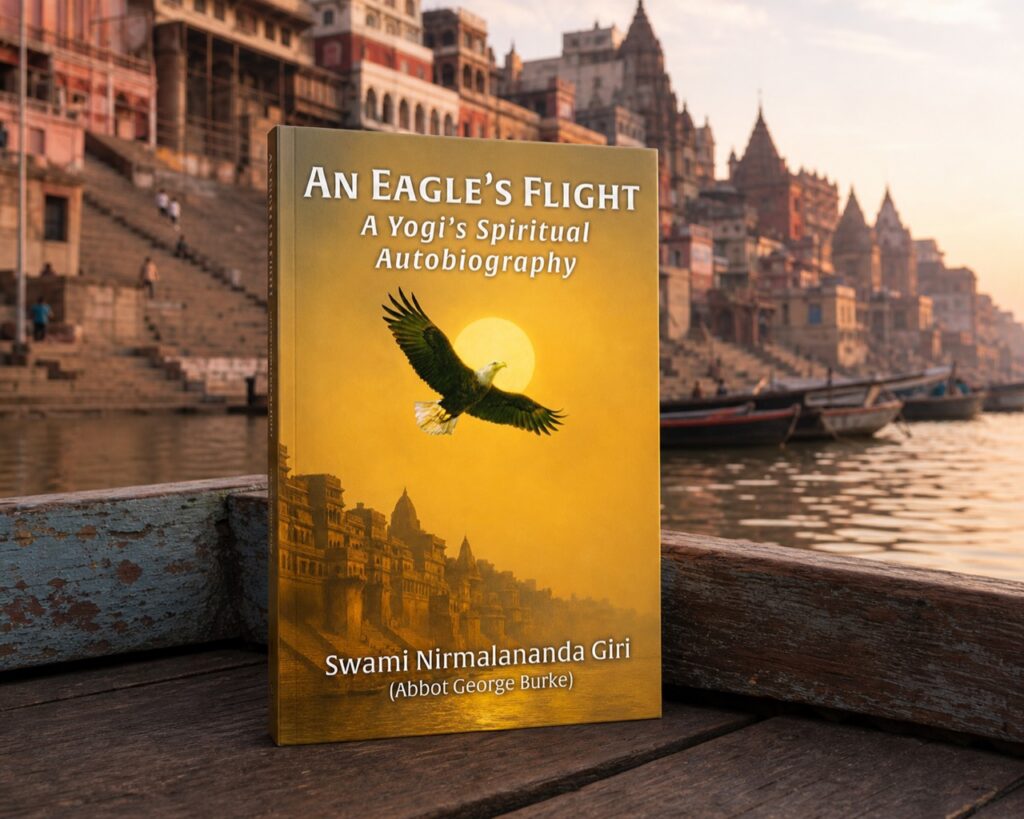
A book to live with
Why Read This Book?
Follow the spiritual awakening of a Western seeker raised in evangelical Christianity as reincarnation, the Bhagavad Gita, yoga, and meditation opened a larger religious world.
Meet Anandamayi Ma, Swami Sivananda, disciples of Yogananda, and many other saints and yogis through the author’s firsthand recollections of India.
Explore karma, meditation, spiritual discrimination, and authentic teaching through a candid account that includes mistakes, humor, and hard-won discoveries.
See a lifelong search for direct realization culminate in Soham Yoga, followed by the substantial “Blessed Memories” record of holy people whose company shaped the author’s life.

Experience the writing
From the Book
Featured excerpt
The Voice of My Own Soul
Exactly forty-eight hours later I was walking home with my briefcase of textbooks in one hand and the Gita in the other, reading as I went. Interruptions had prevented my reading it straight through, but now I was in the final chapters. I was walking in another world as each page of the Gita became a door to new dimensions of understanding.
My understanding was not intellectual—far from it. Rather, my reading of the Gita was like hearing my own soul speaking freely to me for the first time. Thousands of years before, those immortal words had been spoken by the avatar (Sanskrit for “descender”—an incarnation of God) Krishna to the warrior-yogi Arjuna on the battlefield of Kurukshetra, setting forth a philosophy revealing life itself as the path to enlightenment when lived consciously and correctly. But, as I have said, the voice speaking in the Gita was not from the past but from the Eternal Present, speaking not to my egoic mind but to the Eternal in me—far beyond any conceptualizations or conditionings. I was not learning anything new: I was remembering it.
As I came to the final chapter I was at the door of my house. Stopping only to get out my key and open the door, I entered and sat down on the floor just inside and continued to read.
“Where Lord Krishna is, and Arjuna, great among archers, there, I know, is goodness and peace, and triumph, and glory” (Bhagavad Gita 18:78). These closing words of the Gita were but a beginning for me. Within the chariot of my own being there must be Arjuna, the intelligent will, and Krishna, the light of my own soul, living, breathing, and speaking without hindrance. Then in me, also, there would be goodness and peace, and triumph, and glory.
Sitting on the floor I shed tears of pure soul-relief. At last I had found the truth about the Real—a truth as eternal, pure, and beyond taint or shadow as was He to Whom it led. And to Him I offered the gratitude of my spirit for having at long last found that truth. The agony of nearly seven years was ended. Now I could hope again.
Excerpt twoI Had Come Home+
My response to India was all the more dramatic because of the fact that in this present incarnation I had never felt at home anywhere, nor had I ever felt a real kinship with those around me. I loved my family and appreciated their goodness to me, yet I clearly remember sitting on my mother’s lap, looking at the assembled relatives, and asking myself: “Who are these people? They are not mine. And I don’t belong in this place at all. As soon as I can I am going to find the place where I belong and my people.” When at the age of nine I read in The Man Without a Country the words of Sir Walter Scott: “Breathes there a man with soul so dead that never to himself has said, ‘This is my own, my native land’?” I looked up from the page and inwardly answered: “Yes. I am such a ‘man.’ I have no country that is mine, no people that are mine.” Yet, in nightly dreams I wandered in a land far different from what I knew, and I wandered through buildings of an architecture strange to me. And I attributed it all to the vagaries of my subconscious.
I was convinced that I had no home on earth nor any people that belonged to me and to whom I belonged. I held that conviction through the years, and even as my plane landed in the predawn darkness of Calcutta. I held it as I went through the tedium of customs and immigration. However, as I stood in the customs shed and watched the three officials there, I thought, “I have never seen anyone like these men. Their minds are right.” I held it as I waited for daylight before calling an SRF-YSS member in Calcutta as to my further procedure, and then called for a taxi. I held it as I stepped through the doorway of Dumdum Airport, which then was literally not one percent of the size of the present great international terminal. But I held it no longer once both feet were through the door and I was seeing my India for the first time in this life, illumined by the rays of a sun that had shone down upon me in countless previous lives as I walked on its blessed soil.
I had come home.
Excerpt threeAt Last I Had Found It+
Eventually I printed out the book and read it through. It gave a great deal of detailed information about the Nath Yogi Sampradaya and included the life and teachings of Sri Gajanana Maharaj, a virtually unknown twentieth-century master yogi of the Nath tradition. (He was not the very famous Gajanana Maharaj of the same name who died in 1910.)
There is an old expression, “honor among thieves,” that means thieves respecting each other’s territory and not trespassing on them. This applies to many “gurus” operating in India and abroad. They do not “blow the whistle” on each other, but say all gurus are to be respected and are really all the same spiritually. Sometimes they even visit each other and prostrate to each other to show their universal outlook and reverence. They also insist that all paths lead to the one goal, so no one path is better than another. This is all insincere, but seems very positive, open and spiritual to the uninformed and the unwary.
So I was utterly astounded to read that Gajanana Maharaj openly and often spoke of “false gurus” and “false yogas.” He often delineated the characteristics by which they could be detected as frauds. Having lived through the American yoga boom that began in 1967 and lasted about ten or a dozen years before evaporating almost totally, I was very aware of such gurus and yogas. And my respect for Maharaj was increased. He did not lie to get followers.
But his teachings held something vastly more important. He also explained the nature of a genuine sadguru as one who simply teaches the way to Self-realization to others as their friend—not a “master” or a necessary link to God. And even more important, he taught the authentic yoga that would lead to Self-realization: Soham Yoga sadhana. I tried it and within five minutes realized that at last I had Found It. I continue to realize it every day at every meditation.