Dharma for Awakening
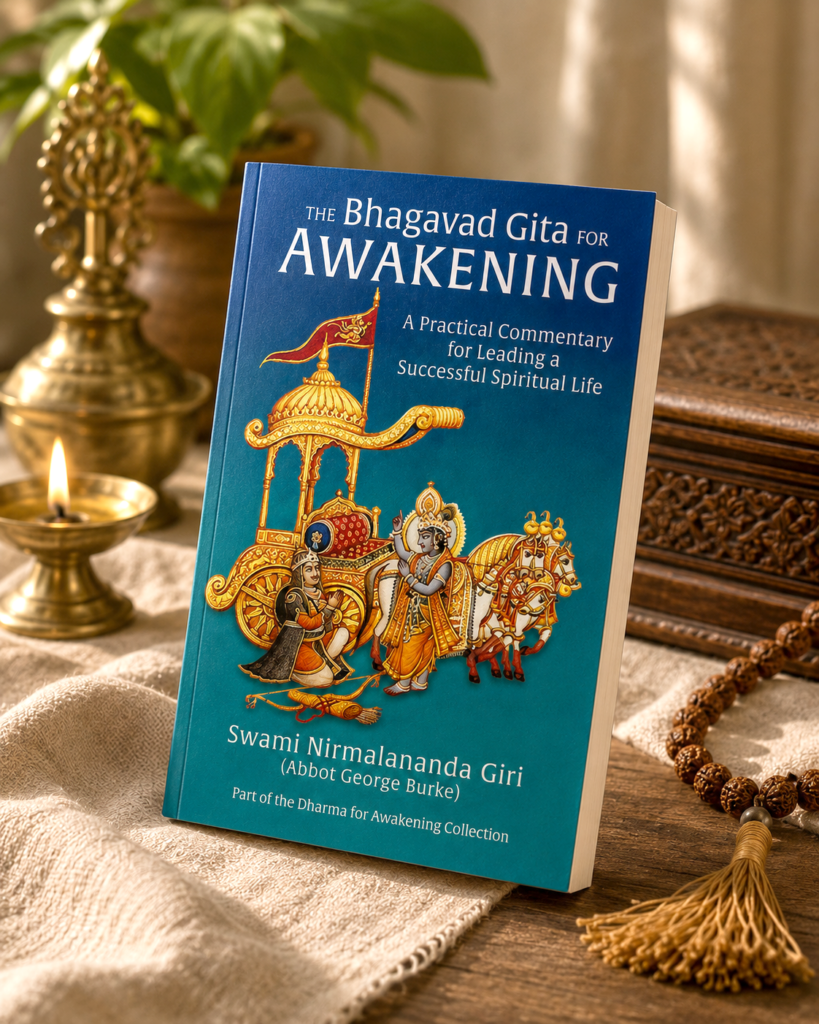
The Bhagavad Gitafor Awakening
A Practical Commentary for Leading a Successful Spiritual Life

Several thousand years ago, on the eve of a great battle, the warrior Arjuna faced a crisis that was at once outward and inward. Confused about his duty and shaken by what lay before him, he turned to Krishna, the Master of Yoga, and asked the questions that confront every serious spiritual seeker: How should I understand what is happening? How should I live? What should I do?
Krishna’s answer became the Bhagavad Gita—seven hundred verses that encompass far more than the circumstances of an ancient battlefield. The Gita speaks of the immortal Self, the nature of God and creation, karma and right action, meditation and yoga, devotion and knowledge, the workings of the mind, and the path to liberation. Again and again, its teachings return the seeker to the central task of spiritual life: to know who we really are and to live from that knowledge.
In The Bhagavad Gita for Awakening, Swami Nirmalananda Giri approaches the Gita not primarily as a work of philosophy to be analyzed, but as a practical guide to awakening. Drawing on a lifetime of study, meditation, and spiritual experience, he explores Krishna’s teachings verse by verse and shows how they apply to the actual problems, choices, disciplines, and possibilities of spiritual life. His commentary is enriched by insights from the Upanishads and Yoga Sutras, the teachings of India’s saints and sages, and illuminating parallels from the Christian spiritual tradition.
At the heart of the commentary is the conviction that the Gita is meant to be lived. Its purpose is not merely to tell us about the Self, but to lead us toward Self-knowledge; not merely to describe yoga, but to show how spiritual practice can transform consciousness and free us from the ignorance that binds us. The Gita, as Swami Nirmalananda writes, points the way to embody its teachings and gain practical experience of their eternal truth.
The Bhagavad Gita tells us that we can attain a Knowing beyond even what it tells us. And it shows us the way.
A book to live with
Why Read This Book?
Discover the Bhagavad Gita as a guide to actual spiritual life, not merely a philosophical or historical text.
Explore the Gita’s essential teachings on the Self, karma, meditation, right action, devotion, and liberation, within one coherent spiritual vision.
Understand how Krishna’s teachings apply to everyday life and spiritual practice, with practical guidance for the mind, our choices, responsibilities, and difficulties.
Go more deeply into the Gita’s wisdom through the Upanishads, Yoga Sutras, and teachings of India’s saints and sages, with illuminating parallels from the Christian spiritual tradition.

Experience the writing
From the Book
Featured excerpt
The Gita as a Book of Life
The miracle of the Gita
The Bhagavad Gita is a marvel of practical wisdom. In the Upanishads we find the truth about Brahman, Atman, and Creation, but it is mostly speculative, intended to awaken the hearer to the intuition of How Things Are–not to merely instruct or convince him. After reading the Upanishads the question of realizing the truths set forth therein becomes most crucial. Since we presently live two lives, the inner and the outer, we need guidance in how to lead both of them in such a manner that the Upanishadic Vision will in time be permanently established in our own consciousness. And that state will be liberation (moksha).
To enable us to attain liberation, two books have been given us: the Bhagavad Gita for our outer, active life, and the Yoga Darshan (Yoga Sutras) for our inner, meditative life. Both contain counsel about the inner and outer way to realization, but each focuses mainly on one sphere. The Bhagavad Gita is the ultimate statement on How To Live.
Yet it perfectly embodies and presents the philosophical principles of the Upanishads.… The Gita is a digest of the Upanishads, but also much more: it points the way to embody their teachings, to gain practical experience of their eternal truth, of Sanatana Dharma.
Excerpt twoThe Balance of the Yoga Life+
A general principle
Now Krishna gives us a general principle for our way of life:
Yoga is not eating too much, nor is it virtually not eating at all; not the habit of sleeping too much, and not keeping awake too much, either. For him who is moderate in food and diversion, disciplined in action, moderate in sleep and waking, yoga destroys all suffering (6:16-17).
Prabhavananda puts it very smoothly: “Yoga is not for the man who overeats, or for him who fasts excessively. It is not for him who sleeps too much, or for the keeper of exaggerated vigils. Let a man be moderate in his eating and his recreation, moderately active, moderate in sleep and in wakefulness. He will find that yoga takes away all his unhappiness.”
Except in the matters of yama and niyama, which are absolutes, moderation is the yogi’s motto. Cool-headedness is essential for him. As Sri Ramakrishna often remarked, crazes and extremes are detrimental to spiritual life. This is especially true because crazes and extremes often mask or express mental and spiritual pathologies. We should be enthusiastic about the spiritual life, but we must be equally sensible and moderate. Then yoga will be for us.
Excerpt threeBeholding the Self+
When the mind comes to rest, restrained by the practice of yoga, beholding the Self by the Self, he is content in the Self (6:20).
There is no way to enter into the state of enlightenment except through yoga. Certainly we sometimes hear of rare individuals who entered into perfect knowledge of the Self with minimal effort or even upon merely hearing of the Self. But such persons have attained illumination in previous lives. There are no shortcuts to enlightenment.
When the mind ceases its movements and becomes permanently stilled, the Self is known. As long as the surface of water is moving to any degree there is distortion in the reflected image, but once it comes to absolute stillness, the image is perfect (complete) and undistorted. It is the same with the mind. The mind can be likened to a double-sided mirror which reflects both the outer world and the inner Self. Both sides must be stilled through yoga. Then the yogi finds profound peace and rests contented in the Self. Only in the illumined Self does he behold (know) the Self. For it is swayamprakasha, self-illuminated and self-illuminating.
Continue the journey
Continue Exploring
Companion books and approved resources for going further.