Original Christianity
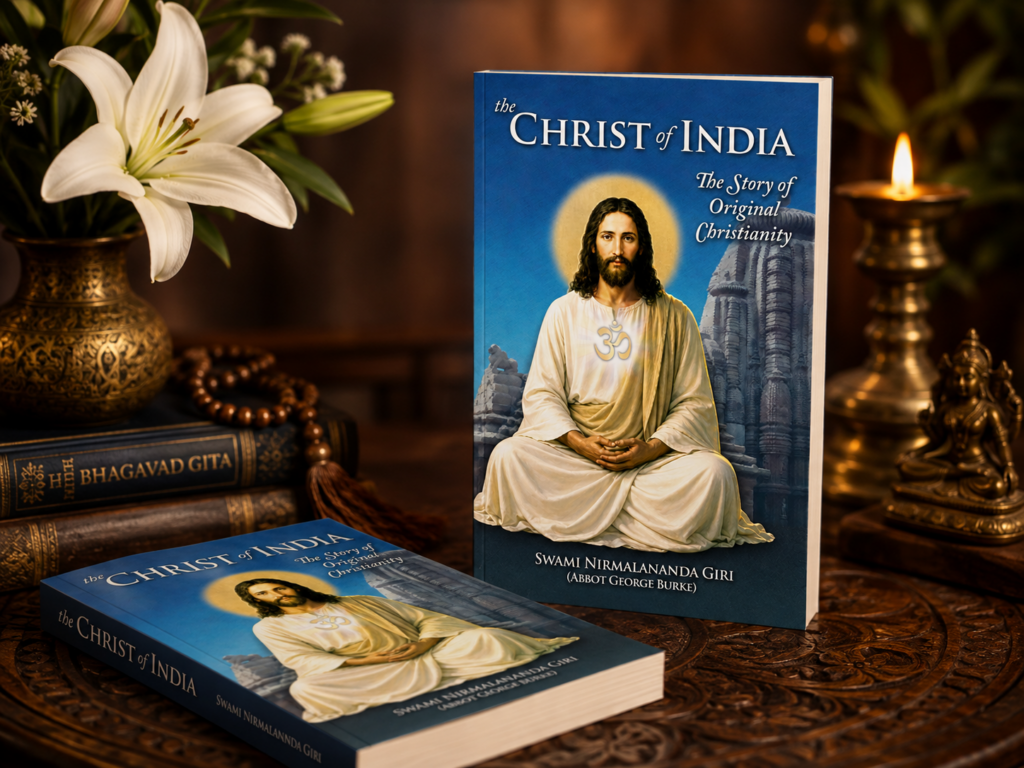
The Christ of India
The Story of Original Christianity

What was the original Christianity taught by Jesus and his earliest followers—and what relationship might it have to the spiritual traditions of India?
In The Christ of India, Swami Nirmalananda Giri presents a provocative and wide-ranging account of Jesus, the Apostle Thomas, and the form of Christianity he believes emerged from their contact with India. Drawing upon traditions, historical accounts, spiritual literature, and his own encounters and research in India, he explores evidence and testimony concerning Jesus’ “lost years,” the traditions that place him in India and Tibet, and the ancient Saint Thomas Christian communities of South India.
Central to the book is the author’s conviction that Jesus should be understood in the context of Sanatana Dharma—the Eternal Dharma of India—and the tradition of yoga. He examines the Essene background of Jesus, accounts of his spiritual training in India, traditions concerning his return there after the crucifixion, and testimony about Jesus preserved by Indian yogis, monasteries, and spiritual teachers. The manuscript explicitly presents this as the framework necessary for understanding what the author calls Original Christianity.
The story then turns to Saint Thomas, whom ancient Christian tradition associates with India. Swami Nirmalananda traces the distinctive spiritual character he attributes to the early Saint Thomas Christians, their relationship to Indian religious life, and the later encounters with European colonial Christianity that profoundly altered their traditions.
But this is more than an alternative history of Christianity. The book asks what Original Christianity means as a spiritual path. Its central section presents the beliefs the author identifies with the teaching of Jesus: the divine nature of the individual spirit, karma and reincarnation, spiritual evolution, Self-realization, and yoga as a means of direct spiritual experience. In the author’s view, these teachings are not a new religion created in first-century Palestine, but expressions of the same Eternal Dharma found in the Upanishads, Bhagavad Gita, and Yoga Sutras.
Two concluding appendices broaden that picture through accounts of Indian spiritual masters who regarded Jesus as one of their own and through an examination of Jesus in relation to the Nath Yogi tradition and Soham Yoga. The result is a book intended not simply to reconsider where Jesus may have traveled, but to ask a more fundamental question: What changes when Jesus is understood through the spiritual world of India?
A book to live with
Why Read This Book?
Explore the traditions and historical accounts connecting Jesus with India, including his “lost years,” spiritual training, and traditions concerning his life after the crucifixion.
Discover the remarkable story of Saint Thomas Christianity in India, its distinctive early character, and its later encounter with European colonial Christianity.
Examine Christianity through the perspective of Sanatana Dharma and yoga, including karma, reincarnation, Self-realization, and the divine nature of the individual spirit.
Encounter Indian perspectives on Jesus, from Ramakrishna, Yogananda, Sivananda and other spiritual figures to traditions associating Jesus with the Nath Yogis and Soham Yoga.

Experience the writing
From the Book
Featured excerpt
What Is Original Christianity?
“Original Christianity” is the teaching of both Jesus of Nazareth and his Apostle Saint Thomas in India. But although it was new to the Mediterranean world, it was really the classical, traditional teachings of the ancient rishis of India that even today comprise Sanatana Dharma, the Eternal Dharma, that goes far beyond religion into actual realization through the practice of yoga. (See Appendix Two: The Yoga of the Nath Yogis and Jesus.) The material in this book will reveal that this statement is simple fact without exaggeration.
Jesus and the Apostle Thomas taught nothing new in either Israel or India. Their religion was identical with that which Jesus studied in India, that which is found in the Upanishads, the Bhagavad Gita and other fundamental scriptures and spiritual writings of India. Jesus and Saint Thomas taught nothing but Sanatana Dharma. The deformed entity known today as “Christianity” is a corruption and betrayal of their actual teachings. Jesus learned his wisdom from the sages of India and so must those who would follow him.
I am not the originator of this idea. In 1920 Swami (later Paramhansa) Yogananda came to America to speak at a religious conference in Boston, Massachusetts. In his discourse at that conference he announced that he would be remaining in America and giving weekly classes of one and a half hours in length: the first half hour would be on the teachings of the Bhagavad Gita, the second on the teachings of the Gospels, and the third on the fundamental unity of the two. For thirty-two years he held to this approach. Today many people in East and West carry on that vision. I am just one of them.
Paramhansa Yogananda was continually denounced by Christians as a Hindu missionary trying to fool Christians into converting to Hinduism, and denounced by Hindus as a Christian missionary trying to fool Hindus into converting to Christianity. He was, of course, simply presenting the truth, historically and philosophically. This book is an attempt to do the same. Those who would follow Christ in all honesty will eventually find themselves following him to India.
Excerpt twoThe Records of Jesus in India+
A contemporary written record of the life and teachings of Jesus in India was discovered in 1887 by the Russian traveler Nicholas Notovitch during his wanderings in Ladakh. He had it translated from the Tibetan text (the original, kept in the Marbour monastery near Lhasa, was in Pali) and, despite intense opposition from Christians in Russia and Europe, published it in his book The Unknown Life of Jesus Christ. When in Rome presenting his findings, he was advised by two high-ranking church officials that he should not print the book. One of them, however, told him that there were manuscripts dealing with Jesus’ life and study in India kept in secret in the Vatican library.
As would be expected, the authenticity of Notovitch’s book was attacked by the Christian missionaries and various articles written claiming that the monks of the Himis monastery, where Notovitch had found the manuscript, told investigators that they knew nothing of Notovitch or the text. But both Swami Abhedananda and Swami Trigunatitananda–direct disciples of Sri Ramakrishna and preachers of Vedanta in America–went at separate times to the Himis monastery. The monks there not only assured them that Notovitch had spent some time in the monastery as he claimed, they also showed them the manuscript, part of which they translated for Swami Abhedananda, who knew from having read Notovitch’s book that it was indeed the same writing found in The Unknown Life of Jesus Christ. Subsequently, Abhedananda had the English translation of Notovitch’s text printed in India where the Christian authorities had until then prohibited both its publication and its importation and sale.
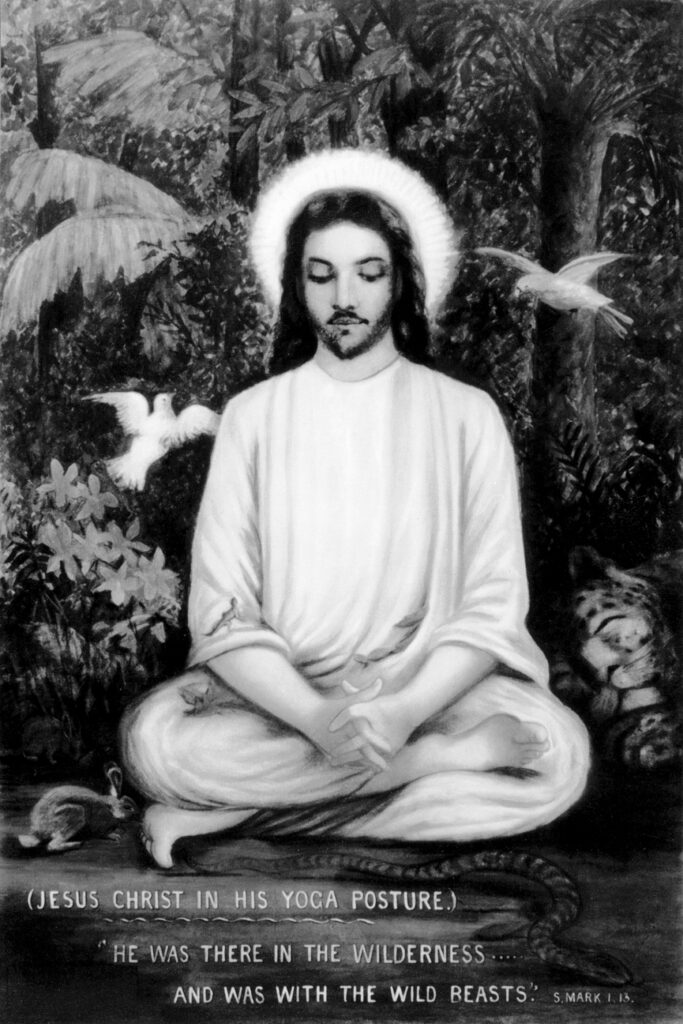
Swami Trigunatitananda not only saw the manuscript in Himis, he also was shown two paintings of Jesus. One was a depiction of his conversation with the Samaritan Woman at the well. The other was of Jesus meditating in the Himalayan forest surrounded by wild beasts that were tamed by his very presence. In America the Swami described the painting to an artist who produced the following:
When Swami Abhedananda was in the Himis monastery doing his research on the records of Jesus life in India, he was told by the abbot that Jesus had not departed from the earth at the time his apostles saw him ascend, but that he had returned to India where he lived with the Himalayan yogis for many years.
Excerpt threeDharma Is a Way of Life+
First of all: What is dharma? Mere philosophy or theology is totally useless if it is not supported by a way of life that enables the individual to unfold and bring to perfection the qualities that are the eternal nature of every individual spirit or jiva. Those principles and practices which comprise such an enabling life are what we mean by dharma. A philosophical view is only a darshan, an intellectual view of the way things are. Such is necessary, but only insofar as it leads to the mode of living that is dharma.
True dharma was directly perceived by the rishis of India. Known as Sanatana (Eternal) Dharma, it reveals the Eternal Being, the Sanatana Purusha. That which is in accord with Sanatana Dharma is true; that which is not is untrue, because Sanatana Dharma is not a religion: it is Truth. Religions are usually degenerations of truth and confuse the issue.
Before any exposition, it should be made very clear that the teachings of Sanatana Dharma (and therefore of original Christianity) are not a set of imposed dogmas, but rather a way of spiritual life. This is why Saint Paul, contrasting the Christian way with that of the Mosaic Law, wrote that God “hath made us able ministers of the new testament; not of the letter, but of the spirit: for the letter killeth, but the spirit giveth life” (II Corinthians 3:6). Emphasis is on spiritual practice (yoga meditation) and observance (the disciplines of yama and niyama, defined in the Glossary at the end of this book) and the experience and knowledge gained from such practice and observance, rather than the intellectual concepts of theology and dogma. There is a broad framework within which spiritual life is pursued, but theological details are left up to the individual. Yet there are certain concepts which, when rightly understood as metaphysical rules of the spiritual road, facilitate the individual’s seeking. They need not be blindly believed, but it helps to accept them provisionally–that is, with an open mind and the understanding that in time the seeker will come to know for himself their truth and relevance.
Continue the journey
Continue Exploring
Companion books and approved resources for going further.