Hinduism & Sanatana Dharma
Sanatana Dharma
The Eternal Religion

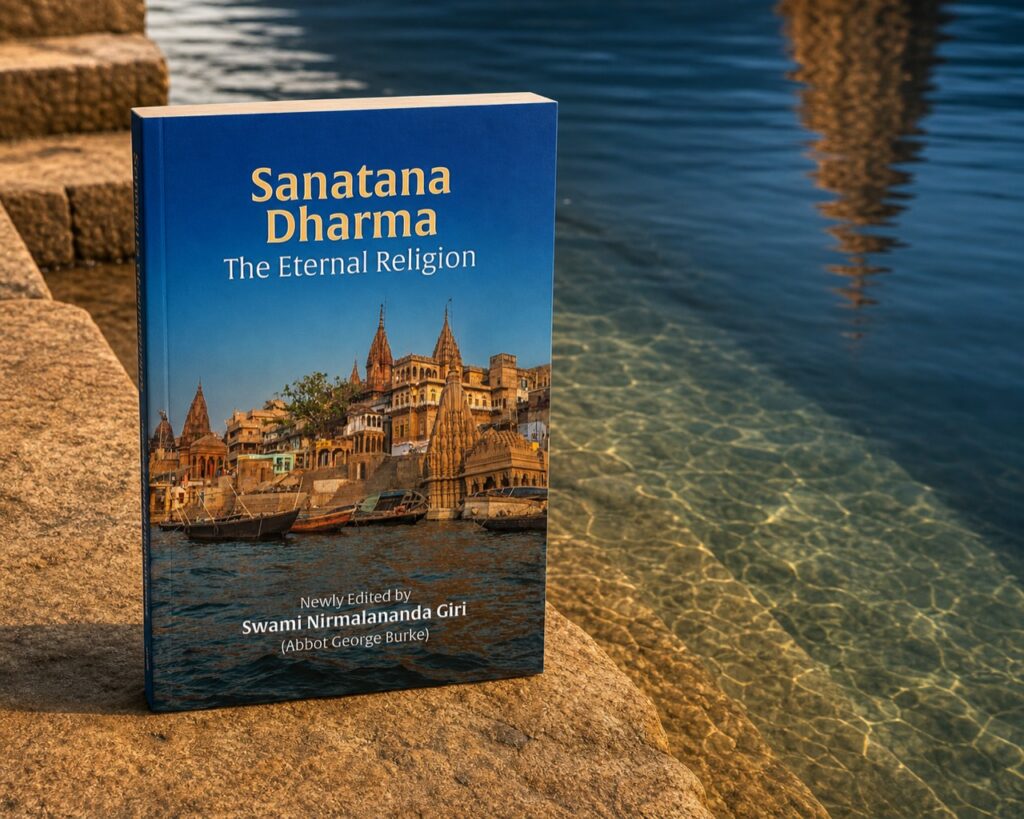
Sanatana Dharma: The Eternal Religion offers a substantial yet approachable foundation in the spiritual worldview commonly called Hinduism. It presents Sanatana Dharma not chiefly as a collection of customs or unusual beliefs, but as an account of “the way things are”: the nature of reality, the individual spirit, the cosmos, and the path by which human life can move toward liberation.
The work grew out of Sanatana Dharma, An Advanced Text Book of Hindu Religion and Ethics, originally prepared in Varanasi for students associated with the Central Hindu College, later Benares Hindu University. Swami Nirmalananda Giri has newly edited the historical textbook for contemporary readers, retaining its systematic character while making its teachings more readily accessible.
Its scope is broad but coherent. The reader encounters Brahman and Atman, karma and rebirth, the visible and invisible worlds, spiritual evolution, the great philosophical systems, and the liberation toward which religious life is directed. These teachings provide the larger framework within which yoga and Vedanta can be understood.
The book also turns from doctrine to practice: mantra, worship, sacrifice, purity, the stages of life, control of mind and senses, duty, virtue, and human relationships. A concluding selection from the Manu Smriti emphasizes Supreme Dharma, Self-knowledge, and knowledge of Brahman, showing ethical life as preparation for realization rather than as an end in itself.
For Western readers meeting classical Hindu terminology, for students of yoga and Vedanta seeking the tradition behind their practice, and for experienced seekers wanting a dependable reference, this is the more foundational of LOSP’s two complementary textbooks on Sanatana Dharma. Readers ready to go deeper can continue with Hinduism: The Universal Religion, the more advanced study.
A book to live with
Why Read This Book?
Build a coherent foundation in Brahman, Atman, karma, rebirth, spiritual evolution, the visible and invisible worlds, and liberation.
See religious life in practice through mantra, worship, sacrifice, purity, the ashramas, and spiritual discipline in everyday life.
Understand dharma and ethical living through duty, virtue and vice, control of mind and senses, human relationships, and the spiritual purpose of conduct.
Explore selected teachings of the Manu Smriti on Supreme Dharma, Self-knowledge, and knowledge of Brahman.

Experience the writing
From the Book
PDF p. 7
Dharma: More Than Belief
The religion based on the Vedas, the Sanatana Dharma, or Vedic Dharma, is the oldest of living religions, and stands unrivalled in the depth and splendor of its philosophy, while it yields to none in the purity of its ethical teachings and in the flexibility and varied adaptation of its rites and ceremonies. “It is like a river, which has shallows that a child may play in, and depths which the strongest diver cannot fathom.” It is thus adapted to every human need, and there is nothing which any religion can supply to add to its rounded perfection. The more it is studied, the more does it illuminate the intellect and satisfy the heart. Those who learn it are laying up for themselves a sure increaser of happiness, a sure consolation in trouble, for the rest of their life.
“That which supports, that which holds together the peoples (of the universe), that is dharma.” Dharma is not merely a set of beliefs having no necessary connection with the daily life of humanity, but is the very principles of a healthy and beneficent life. Therefore to know those principles and act upon them is to be a true aryan–follower of Vedic Dharma–and to tread the sure road to happiness, individual as well as general. (See the Glossary for the correct meaning of “aryan.”) The etymological meaning of “religion” is also the same, “that which binds together.” “Vedic” means “pertaining to the Veda or Perfect Knowledge.” Hence Vedic Dharma means “the Religion of Perfect Knowledge.”
One of the most remarkable things in the Sanatana religion is the way in which it has laid down a complete scheme of knowledge, and has then crowned it with a philosophy composed of six faces (the six darshanas or systems of philosophy), though governed by one idea and leading to one goal. No such comprehensive and orderly view of human knowledge is elsewhere to be found.
PDF p. 10The Self Is Bliss+
The object of all the Darshanas is the same: to rescue men from suffering. And the way of rescue is the same: the removal of ignorance–which is bandha, bondage–and consequent union with the Supreme. Thus the Nyaya calls ignorance, mithyajnana, false knowledge. The Sankhya calls it avivekah, non-discrimination between the Real and the unreal. And the Vedanta calls it avidya, nescience. Each philosophy aims at its removal by jnana, wisdom, whereupon ananda, bliss, is enjoyed. This ananda is the nature of the Self, and therefore cannot accurately be said to be obtained. The Self is Bliss, and it is only necessary to remove the illusion which causes suffering in order that Bliss may be enjoyed. The Nyaya hence speaks of its object as apavarga, salvation or deliverance, and moksha or mukti, liberation, is the universally accepted goal.
PDF pp. 147–148Supreme Dharma and Knowledge of the Self+
What really matters is his teaching given to the sages of India in prehistory. “Manu” means: thinking; intelligent; wise. “Smriti” means “that which was heard and is remembered.” So we should examine those parts of the Manu Smriti that deal with the Supreme Dharma (Param Dharma) which embraces both Atmajnana, Knowledge of the Self, and Brahmajnana, Knowledge of Brahman the Absolute Being. What also matters is the fact that for countless thousands and thousands of years this dharma was the norm in Aryavarta, Bharatvarsha: India. The equally countless number of enlightened men and women in India were the embodiments of Manava Dharma.
And what is Dharma? It is the righteous aspiration, perspective and practical way of living as enjoined by the dharma shastras (scriptures) and the spiritually illumined. It is not meant to be a high ideal only for the spiritually gifted, but the norm for all human beings that aspire to the revelation and manifestation of their own innate divinity: the yogis. The Manu Smriti is the most authoritative–and the foundation–of all the dharmashastras of India.
I am confining this commentary to the teachings of Manu that relate to spiritual life and have meaning for all human beings who wish to attain higher consciousness.
It is very easy to miss the very important principle implied in this passage. The sages ask Manu as one who possesses knowledge of the Self to reveal to them the sacred laws, implying that knowing and following those laws will lead whoever follows them fully and perfectly to Self-knowledge (Atmajnana). Only those who follow Sanatana Dharma, the Eternal Religion, will come to know the Eternal One, the divine Self, which to those without this knowledge is certainly “unknowable and unfathomable.”
Continue the journey
Continue Exploring
Companion books and approved resources for going further.