Dharma for Awakening
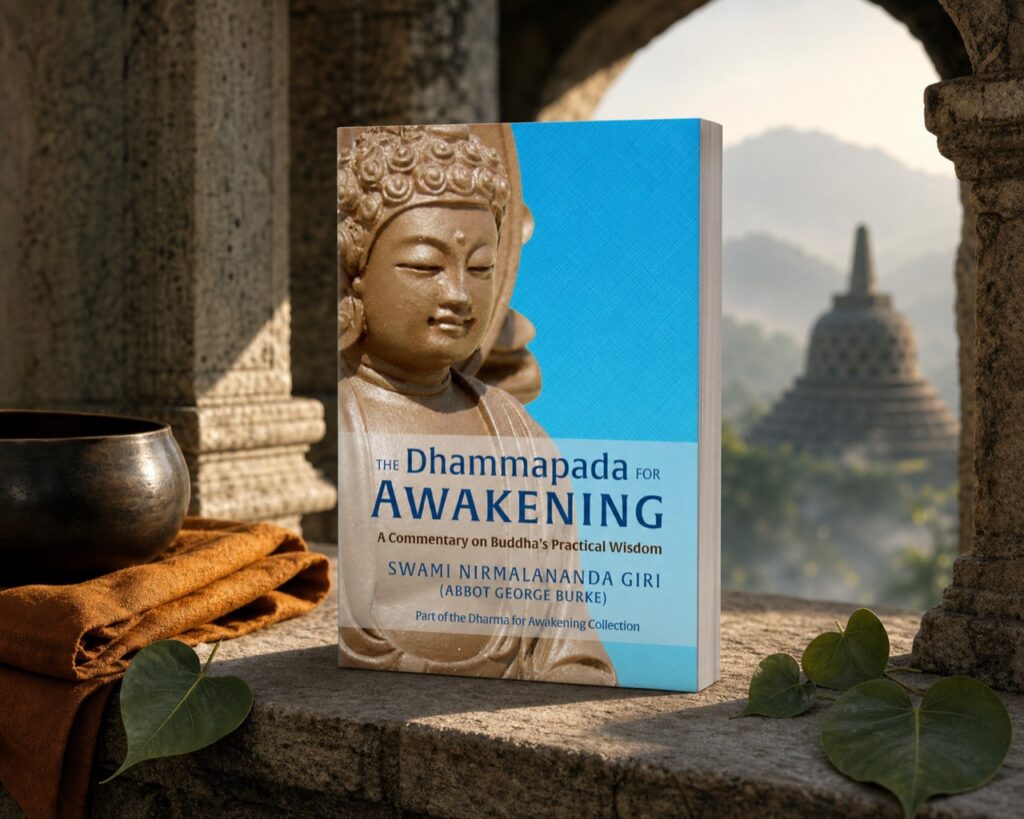
The Dhammapadafor Awakening
A Commentary on Buddha’s Practical Wisdom

The Dhammapada is one of the clearest and most practical expressions of the Buddha’s teaching: 423 verses distilled from decades of instruction on the mind, conduct, suffering, wisdom, meditation, and the path to freedom. Rather than presenting an abstract system of philosophy, it repeatedly asks the question that matters to the spiritual seeker: How should we live if we genuinely want to become free?
In The Dhammapada for Awakening, Swami Nirmalananda Giri explores these teachings as a practical guide to spiritual life. Beginning with the Buddha’s declaration that our experience is governed and shaped by the mind, the commentary examines how thought, intention, action, discipline, meditation, and understanding create the conditions either for bondage or for awakening.
Swami Nirmalananda brings to the text a lifetime of study and practice within the yogic traditions of India, drawing illuminating parallels with the Bhagavad Gita, the teachings of Paramhansa Yogananda and other spiritual masters, and, where relevant, the teachings of Jesus. These comparisons are not used to blur the distinctiveness of the Buddha’s teaching, but to show how universal spiritual principles reappear across traditions.
Above all, this is a commentary concerned with application. What do our thoughts create? Why does suffering arise? How should we respond to injury and conflict? What must be purified? Why is meditation indispensable? And what can another teacher actually do for us on a path that ultimately has to be walked for ourselves?
Again and again, the Buddha’s answer is uncompromisingly practical: teachers can point out the way, but awakening is something the seeker must undertake.
A book to live with
Why Read This Book?
Discover the Buddha’s teachings as practical guidance for daily life, rather than as an abstract philosophy or historical religion.
Understand how the mind, thoughts, and actions shape our experience and destiny, and how that knowledge can become a means of freedom.
Explore meditation, ethical discipline, karma, suffering, and liberation through a commentary grounded in both Buddhist and yogic wisdom.
See the universal dimensions of the Buddha’s teaching, illuminated through parallels with the Bhagavad Gita, Jesus, Yogananda, and other spiritual masters.

Experience the writing
From the Book
Featured excerpt
The Way of the Wise
Those who meditate with perseverance, constantly working hard at it, are the wise who experience Nirvana, the ultimate freedom from chains (Dhammapada 23).
Guru Nanak, founder of the Sikh religion, frequently used the expression “godwards” for those who were moving toward Divine Consciousness. We might coin the ungainly word “Nirvanics” for those Buddha is describing in this twenty-third verse of the Dhammapada. They are the wise. As Yogananda said, the world is divided into two types of human beings: the wise who are seeking God and the foolish who are not.
Whatever the terms we may use for “the ultimate freedom from chains,” the idea is the same: right now we are bound, but we can become unbound. How? Buddha is telling us how.
Meditation
One time a man asked me if he could speak with me about some problems and questions he had. “Why bother?” brayed an eavesdropper standing nearby, “All he will do is tell you to meditate!” Yes, it is true: meditation is the only solution. Many things are needed to support our meditation and ensure its success, but meditation is the prime means for those seeking real freedom of being. Paramhansa Yogananda, writing about Yogiraj Shyama Charan Lahiri, one of nineteenth-century India’s greatest yogis, said: “The great guru taught his disciples to avoid theoretical discussion of the scriptures. ‘He only is wise who devotes himself to realizing, not reading only, the ancient revelations,’ he said. ‘Solve all your problems through meditation. Exchange unprofitable religious speculations for actual God-contact. Clear your mind of dogmatic theological debris; let in the fresh, healing waters of direct perception. Attune yourself to the active inner Guidance; the Divine Voice has the answer to every dilemma of life. Though man’s ingenuity for getting himself into trouble appears to be endless, the Infinite Succor is no less resourceful.’”
Long before these wise words of Lahiri Mahasaya, Buddha made clear to his students again and again that meditation was the way to freedom.
Perseverance
Wonderful as it is, meditation is no magic trick. Only those gain its benefit who “meditate with perseverance, constantly working hard at it.” So two things must characterize our meditation practice: constancy and effective effort. We keep on and keep on, never stopping for a moment in the endeavor to continually direct our awareness toward Reality. And that endeavor cannot be done in a lackadaisical manner. The Path is walked, or even run, along, but not shuffled or moseyed along.
The great twentieth-century Roman Catholic philosopher, Dietrich van Hildebrand, wrote in his masterful study of spiritual evolution, Transformation in Christ, that the majority of people suffer from what he calls “discontinuity.” That is, most people simply cannot sustain either effort or thought unless driven by the base passions. In other words, they have no real freedom of mind and will, though they think they do. Addiction impels us, but wisdom does not, for freedom is both its goal and its requisite. Hence, our sustained effort at meditation must come directly from within us as a fully conscious and willful choice. Every day this is true: each step on the path is a conscious choice, clear to the end. This is not a path for the timid or the lazy or the merely curious.
Intent on meditation
Perhaps Richard’s translation: “constantly working hard at it,” is not the best, for meditation is certainly a matter of effort, but not one of stress or strain. The Venerable Thanissaro Bhikkhu renders it “firm in their effort.” We must be focussed, intent, on our practice, certainly exerting will and strength, but in a judicial and cool-headed manner. Constant and steady is the way.
The chains
We are bound by millions (if not billions) of chains, yet meditation pursued rightly will dissolve them all. In the meantime we have to make sure we are not binding more chains on us, like the washed dog that immediately runs out and rolls in the filth to counteract the cleanliness. Here, too, meditation is the answer, for the insight born of meditation enables us to see the folly of bondage and the understanding to turn away from more involvement in chaining ourselves.
Excerpt twoYou Must Do It Yourself+
Purification
This indeed is the Way–there is no other–for the purification of one’s vision. Follow this way. It leads to Mara’s confusion (Dhammapada 274).
Harischandra Kaviratna: “This is the path; there is no other path that leads to purity of insight. Follow this path, for this path bewilders the Evil One (Mara).” Thanissaro Bhikkhu: “Just this is the path–there is no other–to purify vision. Follow it, and that will be Mara’s bewilderment.”
When he says this is the only way, Buddha does not mean this in a narrow sense. Rather, he is saying that all the elements listed previously put together form the only way to Nirvana. Buddha never claimed to be unique and the only one to become enlightened. Actually, he was a very traditional Sankhya yogi who was reviving Arya Dharma in his age.
Purification is the purpose of the path, for we have nothing to attain, only to reclaim, to recover. We are ever the perfect Buddha-Self, but we have lost awareness of that and created a labyrinth of false identities from life to life, piling up mountains of karma beneath which we seem to suffocate. But it is only the false side of us that acts and creates and reaps karma. Once we clear that falsity away, nothing remains but the Truth, the eternal Dharmakaya. That alone is freedom.
Such an attainment eludes the force of cosmic ignorance or Mara, for it is impossible for darkness to perceive the light. We need not battle evil or even reject it. Rather, like Buddha we ignore it and stay intent on our path to Nirvana. Nothing more is needed. Mara is only part of the great dream, as unreal as anything else within it. Awakening is our business, and we must be about it.
Ending suffering
Following this Path you will put an end to suffering. I have taught you the Way after realizing the removal of the arrow myself (Dhammapada 275).
When we are purified, the darkness of ignorance will disappear and so will suffering, for suffering is an illusion, a mirage.
“I have taught you the Way after realizing the removal of the arrow myself” is one of the great statements of the Dhammapada, for no one is a worthy teacher who has not first practiced and come to know the way. A teacher need not be a Buddha, but he must be a “son of the Buddha” whose feet are well along on the path and who will not waver or regress. Even Buddha could not teach what he had not himself already come to know. He often used the simile of an arrow wound in speaking of the desperate condition of ignorant human beings. We cannot live with the arrow, we must remove it–not just philosophize about it or hope that someone comes along one day to remove it. Each one must remove his own arrow. Until he had done so, Buddha did not presume to teach others.
You must do it yourself
Making the effort is your affair. The Buddhas have pointed out the Way. Those who are on the way and practicing meditation will be freed from Mara’s bonds (Dhammapada 276).
No one saves us but we ourselves. No one attains enlightenment except by his own effort, and it is that which must absorb our attention, not intellectualizing, philosophizing, discussing and confusing others by teaching what we do not really know ourselves. It is not just Gautama Buddha who is Self-awakened and Self-enlightened, but everyone who attains the goal. A religion which propounds any savior beyond ourself is a destroyer, an enemy worse than any vice. Even the greatest teacher can do no more than show the way, the rest is up to us. Anyone who claims to be able to help us or do it for us is a liar, especially those who pretend to be able to take on or free us from our karma. Karma is only a dream, and no one can wake up for us; we must awaken ourselves. And meditation, which is purely individual, is the way to awakening
Excerpt threeThe Good Discipline Themselves+
Navies [irrigators] channel water, fletchers fashion arrows, and carpenters work on wood, but the good discipline themselves (Dhammapada 145).
We all have personal definitions of what makes a person good, but Buddha’s is the best. The good do not busy themselves with trying to order others around and change them; they change themselves through self-discipline. They do it all themselves. Buddhas point the way, and they walk it.
“Go, and do thou likewise” (Luke 10:37).
Continue the journey
Continue Exploring
Companion books and approved resources for going further.