Dharma for Awakening
The Gospel of Thomasfor Awakening
A Commentary on Jesus’ Sayings as Recorded by the Apostle Thomas

In 1945, a collection of ancient Christian writings discovered near Nag Hammadi, Egypt, brought renewed attention to a remarkable text: the Gospel of Thomas, a collection of 114 sayings attributed to Jesus and traditionally associated with the Apostle Thomas. Unlike the familiar narrative Gospels, Thomas contains no continuous story of Jesus’ life. It presents his teachings directly—often in brief, enigmatic sayings that challenge the reader to look beyond their surface meaning.
In The Gospel of Thomas for Awakening, Swami Nirmalananda Giri approaches these sayings as practical teachings of spiritual transformation. Rather than concentrating primarily on textual controversies or historical reconstruction, he asks what Jesus’ words mean for the person seeking higher consciousness and direct spiritual knowledge today.
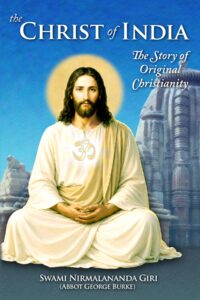
Central to the commentary is Swami Nirmalananda’s understanding of what he calls Original Christianity: a spiritual tradition closely related to the wisdom of India and to the teachings Jesus encountered there. The book’s introduction sets this interpretation within the author’s larger account of Jesus, Saint Thomas, India, and the early Christian traditions explored more fully in The Christ of India.
Saying by saying, the commentary draws upon the canonical Gospels, the Bhagavad Gita, yoga, the Christian mystical tradition, and other sources to illuminate Jesus’ teaching about the Kingdom, Self-knowledge, spiritual discernment, inner transformation, and direct experience of God. The emphasis throughout is not simply on understanding Jesus intellectually, but on putting his teaching into practice and moving forward in consciousness.
Because the sayings are treated individually in relatively short chapters, the book lends itself naturally to daily reading, meditation, and group study. The result is a Gospel commentary meant not merely to explain an ancient text, but to challenge the reader to discover what Jesus’ words demand of the spiritual seeker here and now.

A book to live with
Why Read This Book?
Explore the 114 sayings of the Gospel of Thomas as practical teachings for spiritual awakening, rather than merely as an ancient Christian curiosity.
Encounter Jesus through the perspective of Original Christianity, with illuminating connections to yoga, Sanatana Dharma, and the wisdom traditions of India.
Discover parallels among the Gospel of Thomas, the canonical Gospels, the Bhagavad Gita, and mystical Christianity, revealing recurring principles of inner transformation.
Use the book for daily reflection, meditation, or group study, with short chapters that continually return the reader to practical spiritual application.

Experience the writing
From the Book
Featured excerpt
Knowing Rather Than Believing
They said to him, Tell us who you are so that we may believe in you.
He said to them, You read the face of the sky and of the earth, but you have not recognized the one who is before you, and you do not know how to read this moment. (91)
Brown: They say to him: Tell us who thou art, so that we may believe in thee. He says to them: You scrutinize the face of the sky and of the earth–yet you do not recognize Him who is facing you, and you do not know to inquire of Him at this moment.
The disciples have not yet crossed over from mere intellectual assent or belief to the realm of direct intuitional experience that is not believing or accepting but knowing. Therefore they ask Jesus to define himself. Jesus tells them that they are able to tell by the appearance of earth and sky the coming changes in those material things, but they are unable to perceive his nature which transcends them. They neither know him, nor do they know how they should ask him about the way to attain such knowledge.
In the Bhagavad Gita, Arjuna the yoga adept has more understanding, so he says to Krishna: “O Supreme Lord, I wish to behold your Ishwara Form, O Purushottama. If you think it is possible for me to see it, O Lord of Yogis, then show to me your eternal Self” (Bhagavad Gita 11:3-4). As a yogi Arjuna understands that what he desires is a matter of mystical experience far beyond the ordinary mind. That it must be a revelation bestowed on him. So Krishna replies: “You are not able to see me with your own eyes. I give to you the divine eye: behold my Ishwara Power” (Bhagavad Gita 11:8). Then Arjuna sees the divine universal form of Krishna through the spiritual will and power of Krishna.
In the Gospel of Matthew we find this: “When Jesus came into the coasts of Caesarea Philippi, he asked his disciples, saying, Whom do men say that I the Son of man am? And they said, Some say that thou art John the Baptist: some, Elias; and others, Jeremias, or one of the prophets. He saith unto them, But whom say ye that I am? And Simon Peter answered and said, Thou art the Christ, the Son of the living God. And Jesus answered and said unto him, Blessed art thou, Simon Barjona: for flesh and blood hath not revealed it unto thee, but my Father which is in heaven” (Matthew 16:13-17).
As seekers for higher consciousness and knowledge we must realize that they come to us directly from the Supreme Source, the transcendental Being of God.
Excerpt twoThe Kingdom Within+
Rather, the kingdom is inside of you, and it is outside of you. The divine kingdom is right at hand, not far away and unreachable or accessible only through terrible struggles. Yet, we do not see the kingdom, much less dwell within it on a conscious level. What must be done to perceive the kingdom?
When you come to know yourselves, then you will become known. Self-knowledge is essential and imperative.
Excerpt threePutting the Teaching Into Practice+
Jesus said, A city being built on a high mountain and fortified cannot fall, nor can it be hidden. (32)
Each of us is a city according to various spiritual traditions, so we can apply this verse to ourselves.
If we would be successful as human beings, we must build our city–establish ourselves–on the heights of spiritual aspiration, inspiration, and realization. Elevation of consciousness is the only way to do this, not through abstract theorizing and endless word-gaming. Spiritual practice is the way of constructing our life as a city of God.
This city must be protected from the dangers of this world and the forces of ignorance, material and metaphysical. Therefore it must be walled about by the scrupulous practice of discipline and right conduct. This will result in a strength and stability that cannot shaken. One of the best means for this is the Eightfold Path expounded by the Buddha:
- Right view
- Right intention
- Right speech
- Right action
- Right livelihood
- Right effort
- Right mindfulness
- Right meditation
The material world is preceded by the spiritual world; in fact the material world is an extension of the spiritual world. It is necessary, then, that spiritual development and evolution should result in the development and evolution of the outer life. It cannot be hidden if it is real. That is why when a Brahmin met Buddha right after his enlightenment, he was struck with awe at his very appearance. The entire outer life is changed when the inner life is changed. It is inescapable.
Continue the journey
Continue Exploring
Companion books and approved resources for going further.