Original Christianity
Spirit and Life: The Four Gospels for Awakening
A Practical Commentary on the Life and Teachings of Jesus Christ

The four canonical Gospels give us complementary witnesses to the life and teachings of Jesus. Spirit and Life: The Four Gospels for Awakening brings them together into one continuous Gospel harmony and approaches that unified narrative with a practical question: what do the words and actions of Jesus reveal about spiritual life and the awakening of human consciousness?
Published as one major commentary in two volumes, the work follows the harmonized Gospel story from its opening vision of Christ the Word through Jesus’ ministry, teaching, Transfiguration, Passion, Resurrection, and final instructions. Volume 1, The Way of Illumination, establishes the method and follows the earlier movement of the narrative. Volume 2, The Way of Liberation, carries the commentary through the later ministry and the culminating events of the Gospel story.
Swami Nirmalananda Giri writes from an unusual double formation in Christianity and Sanatana Dharma. He frequently places the words of Jesus beside insights from the Bhagavad Gita, Upanishads, yoga philosophy, saints, and mystics. These parallels are not offered to blur traditions together, but to recover dimensions of spiritual instruction that can remain hidden beneath familiar religious language.
Throughout both volumes, attention returns to inner transformation: purification of mind and heart, awakening to divine consciousness, discrimination between outward religion and inward realization, and the practical meaning of following Christ. Familiar Gospel incidents become occasions for examining meditation, karma, rebirth, discipleship, spiritual perception, Christ consciousness, and liberation.
Spirit and Life is for readers who want to encounter Jesus not only as a figure of belief or history, but as a spiritual teacher whose words demand realization. Christians seeking the mystical depth of their own tradition, and students of yoga and Sanatana Dharma who recognize a universal spiritual wisdom in Jesus, will find in this two-volume work a sustained guide to illumination and liberation.
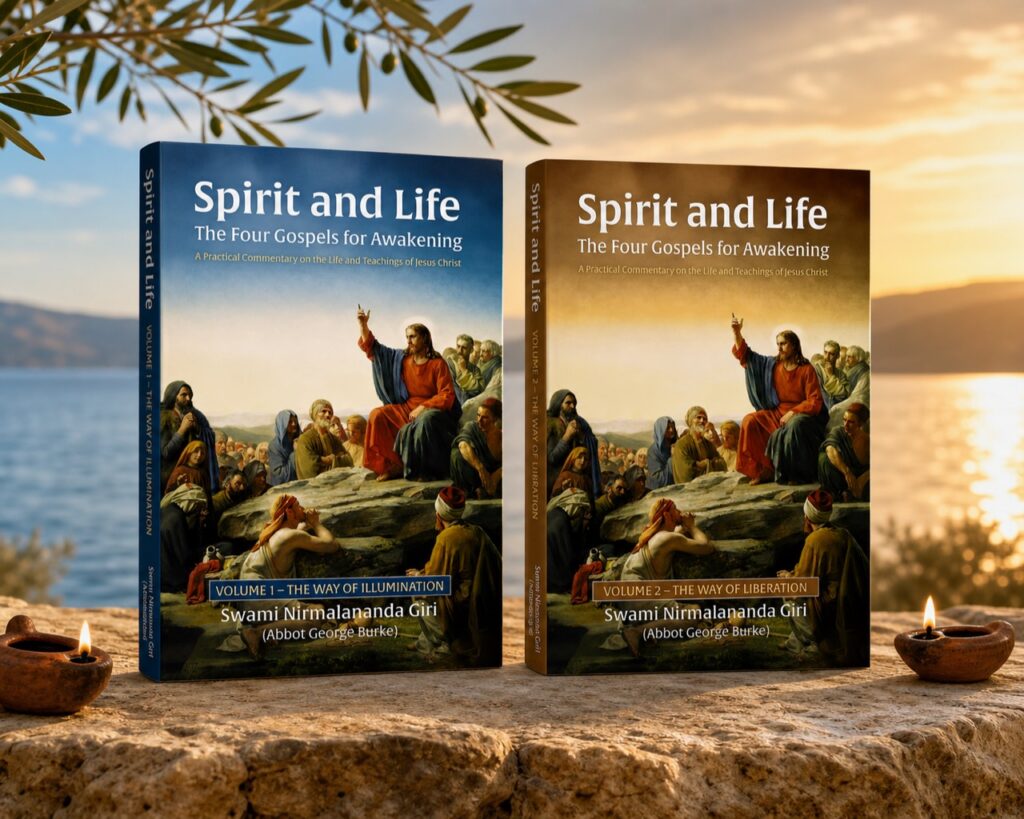
A major two-volume commentary
Why Read This Work?
Read the life and teachings of Jesus as one continuous Gospel harmony, bringing the four canonical accounts into a unified spiritual narrative.
Follow the complete two-volume arc—from Christ the Word and the opening ministry through the Transfiguration, Passion, Resurrection, and final instructions.
Explore illuminating parallels between Jesus’ teachings and the Bhagavad Gita, Upanishads, yoga, Sanatana Dharma, and the world’s mystical traditions.
Approach Christianity as a path of inner transformation: purification, spiritual awakening, direct experience, Christ consciousness, and liberation.

From both volumes
From the Work
Featured excerpt
Why a Harmony of the Gospels?
Volume 1 · The Way of Illumination · Preface · PDF p. 3
This is not a commentary on the four Gospels individually, but on a harmony of the Gospels: one continuous narrative as found in A Harmony of the Gospels For Students of the Life of Christ by A. T. Robertson (published by Harper and Row).
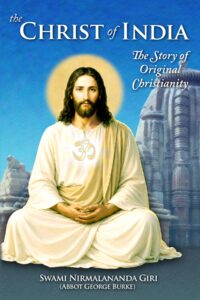
To me, the text commented on here is not a mere biography but a spiritual revelation consisting of both the life and the teachings of Jesus. Naturally, as someone who has a background in both Christianity and Hinduism (Sanatana Dharma), my analysis is a synthesis of western and eastern perspectives which I believe that Jesus himself possessed as I have explained in my book The Christ of India. (Which I am pleased to say has been publicly endorsed and recommended by the Shankaracharya of Puri–Govardan Math.)
Excerpt 2The Change of ConsciousnessVolume 1 · The Way of Illumination · The Sermon on the Mount · PDF pp. 133–134+
However, the change of life Saint John is talking about is an ordering of our life so Divine Consciousness can manifest. It goes far beyond the naughty-or-nice morality of Santa Claus religion. What is needed is a way of life that repolarizes the consciousness, or assists in that repolarization. Acts and thoughts that further our spiritual perfection are good, and those that hinder or reverse our spiritual perfection are bad. It is just that simple.
In the childish mishmash that is commonly thought to be Christianity it is supposed that nothing more is needed than the following of “do” and “don’t do” rules. Consequently many brag about how close they are to God just because of what they do or do not do. But this is only a veneer; it has no heart, so it is dead. What Jesus intended for his disciples was a total change of consciousness, for if the consciousness changes, the life changes; but if the life changes and the consciousness does not change, then nothing is accomplished.
The consciousness must be changed and turned around utterly, and then each step we take will lead us toward God. Even the practice of a divinely-established religion is of little value if the consciousness is not turned inward through meditation, for that is the true way of repentance, the inner path which leads to God.
We must also note that Saint John tells us to turn ourselves around, not to be turned around by anyone else, not even by God. Our self-effort is needed to develop the will that is required for success in spiritual life. How will we manage all this? Again: by meditation, for meditation is the surest changer of the mind and the conduct. And why should we do all this? “For the kingdom of heaven is at hand.” Right here and now. As Buddha said: “Turn around, and lo! the other shore.”
Excerpt 3The True Resurrection into LifeVolume 2 · The Way of Liberation · The Raising of Lazarus · PDF p. 278+
The consciousness of Christ, Christ-consciousness, is the true resurrection into life—the life of Spirit. Remember, the word eis does not mean just in, but into. So Jesus said, “He that believeth into me….”
Christ consciousness is itself life, and those who enter into that consciousness are the only ones who really are alive in the complete sense. And we, too, are destined to become Christs by our entry into our own eternal consciousness—atma-chaitanya—the consciousness that is our Self, our immortal atman. No one truly lives until they resurrect—rise—into that consciousness. Then, although he was once “dead” to higher realities, he will come to life and live in Reality Itself. He then will truly never die, no matter whether his body dies. For then he shall rise into the realms of immortality never to come back into this world of spiritual death. This is the true liberation: moksha.
Continue the journey
Continue Exploring
Companion books and approved resources for going further.