Original Christianity
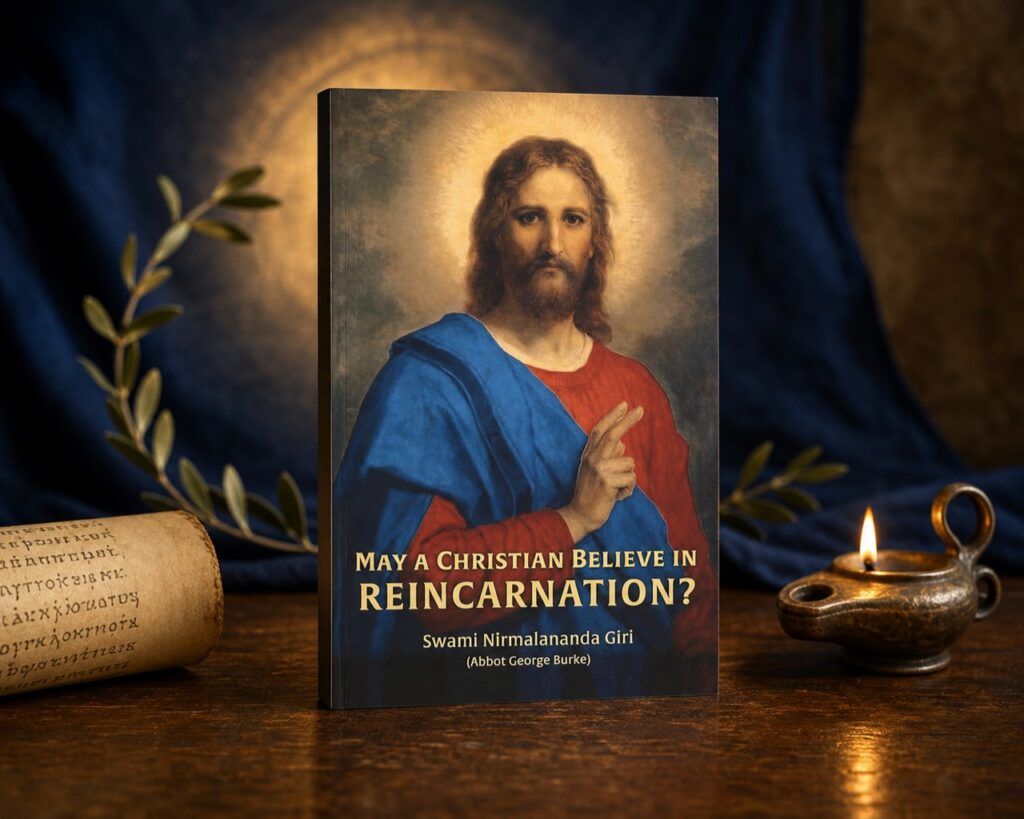
May a Christian Believe in Reincarnation?

May a Christian Believe in Reincarnation? is a concise historical, scriptural, and theological examination of a question many Christians quietly ask: must belief in rebirth be rejected as incompatible with Christianity? Swami Nirmalananda Giri gathers the evidence he considers most important and presents the case directly, as an interpretation advanced by the book rather than as a claim about settled modern scholarly consensus.
The study begins in the religious world from which Christianity emerged. It considers reincarnation in orthodox Jewish thought, Biblical passages read in relation to rebirth, and Jesus’ identification of John the Baptist with the promised return of Elijah. These texts are placed within a wider argument that Jesus and the Apostles would have known Jewish teachings about repeated earthly lives.
The book then turns to early Christianity. Drawing upon Christian writers, saints, theologians, and Church Fathers, it traces testimony that Swami Nirmalananda understands as evidence for reincarnation within the early Church. Karma appears in Biblical language as “sowing and reaping,” while resurrection is distinguished from reincarnation as the final liberation and transformation beyond the necessity of rebirth.
A separate appended essay, Necessity for Reincarnation, by Annie Besant broadens the inquiry. Her argument approaches reincarnation through evolution, moral justice, differences in human development, philosophy, and Christian history. She is the author of this supplementary essay, not a coauthor of Swami Nirmalananda’s main study.
Brief enough to serve as an accessible first step yet rich in source material, the volume is intended for Christians curious about reincarnation, readers of Original Christianity and Christian mysticism, and students of karma and rebirth who want to understand the subject from a Biblical and early-Christian perspective. The complete book may be read or downloaded free.
A book to live with
Why Read This Book?
Examine what Judaism and the Bible say through Jewish sources, scripture, and the religious world of Jesus and the Apostles.
Trace reincarnation in early Christianity through passages from Christian writers, saints, theologians, and Church Fathers.
Explore karma, rebirth, and resurrection as sowing and reaping, repeated earthly lives, spiritual responsibility, and eventual freedom from rebirth.
Consider Annie Besant’s broader case for reincarnation through evolution, justice, human development, and Christian history.

Experience the writing
From the Book
From the Book
The Question Before Us
Our purpose in this brief study is to determine if, in good conscience, a Christian may believe in reincarnation. In ancient orthodox Jewish and Christian writings, as well as the Holy Scriptures, we can find reincarnation–also known as the transmigration of souls–as a fully developed belief. Consequently as Orthodox Jews Jesus and the Apostles would have been familiar with the belief in rebirth.
My favorite comment on the subject of reincarnation is that given by the Roman Catholic Capuchin stigmatist Saint Padre Pio. When one of his spiritual daughters was “told on” for believing in reincarnation, he told her accusers very firmly: “It does not matter what you believe about reincarnation. The only thing that matters is this: Are you seeking for God now?”
From the BookElijah and John the Baptist+
Right away, in the New Testament, we encounter the subject of reincarnation. The Apostles believed that Jesus was the Messiah, but they had one doubt. In the book of Malachi there was the prophecy:
“Behold, I will send you Elijah the prophet before the coming of the great and dreadful day of the Lord” (Malachi 4:5).
If Jesus was the Messiah, Elijah should have preceded him. So “his disciples asked him, saying, Why then say the scribes that Elias [Elijah] must first come? And Jesus answered and said unto them,…I say unto you, that Elias is come already, and they knew him not, but have done unto him whatsoever they listed.…Then the disciples understood that he spake unto them of John the Baptist” (Matthew 17:10, 12, 13).
Previously, speaking to a crowd about John the Baptist, Jesus told them: “This is he, of whom it is written, Behold, I send my messenger before thy face, which shall prepare thy way before thee.…And if ye will receive it, this is Elias, which was for to come” (Matthew 11:10, 14).
Words could hardly be clearer, yet how many Christians today “are willing to receive it”? And they are the words of Jesus himself.
From the BookA Doctrine of Hope and Strength+
Friends, if I speak to you on this tonight, it is because I know what the doctrine has of hope, of strength, of encouragement, in the face of the difficulties in the world. I know what it means for the heart-broken, who fall in despair before the puzzles of life, to have the light thrown upon it which makes life intelligible; for the misery of intellectual unrest is one of the worst miseries that we face in the modern world.
To be able to understand what we are, to be able to understand whence we have come and whither we are going, to see all through the world one law as there is one life, to realize that there is no partiality, no injustice, no unfair treatment of one human soul, no unfair treatment of one human life; that all are growing; that all are evolving; that our elders are those who have had a longer past behind them, our younger those who are still in the childhood of evolution; that no human soul shall suffer for the sin of another, none be arbitrarily favored, none be arbitrarily condemned; that all are growing into the image of the divine, that all shall one day become perfect as their Father in Heaven is perfect. For every one of us is divine. It was from God, it came from God, and to God it returns.
Continue the journey
Continue Exploring
Companion books and approved resources for going further.