Hinduism & Sanatana Dharma
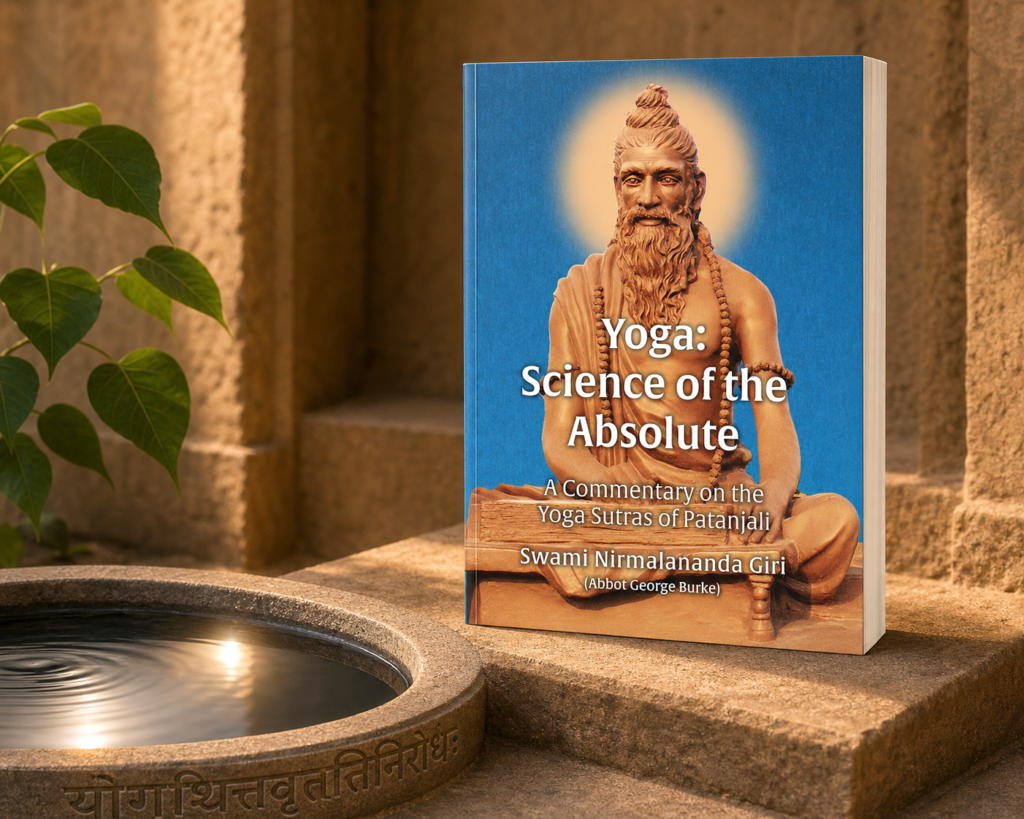
Yoga: Science of the Absolute
A Commentary on the Yoga Sutras of Patanjali

Patanjali’s Yoga Sutras are a foundational text of Yoga both as spiritual practice and as one of the classical darshanas of Sanatana Dharma. Yoga here means the path toward realization and liberation—not merely a system of physical exercise.
The Sutras investigate consciousness, the mind, meditation, obstacles, spiritual discipline, samadhi, and liberation. Their aphorisms are extraordinarily compressed, often placing a complete teaching into only a few words, and they have therefore traditionally required explanation and commentary.
Swami Nirmalananda Giri draws upon the traditional commentarial stream, including Vyasa and Shankara, as well as respected later interpreters such as I. K. Taimni. To this inheritance he adds observations derived from decades of study, meditation, and spiritual practice, without treating his reflections as a replacement for the classical commentators.
The title Science of the Absolute points to Yoga as something to be tested through disciplined practice rather than accepted merely on faith. The commentary continually relates philosophy to meditation, self-observation, the transformation of consciousness, and the direct realization toward which the Sutras lead.
This book is intended for serious students of Yoga, meditators, readers of Patanjali, students of Sanatana Dharma, and those seeking to understand Yoga beyond its modern physical presentation. It welcomes an intelligent beginner while rewarding the sustained attention of readers who return to the Sutras over many years.
A book to live with
Why Read This Book?
Yoga beyond the postures: a study of Yoga as a complete spiritual science directed toward realization of the Self.
Patanjali made understandable: the compact sutras are unfolded in clear language without stripping them of their depth.
Rooted in the classical tradition: the commentary engages Vyasa, Shankara, and respected modern interpreters within the traditional commentarial stream.
Written from practice: philosophy is continually related to meditation, consciousness, discipline, and the actual work of spiritual realization.

Experience the writing
From the Book
Patanjali’s Yoga Sutras · Commentary by Swami Nirmalananda Giri
The Meaning of Yoga
Sutra I.2
Yoga is the inhibition of the modifications of the mind. Yogash chitta-vritti-nirodhah.
Commentary
Chitta is the subtle energy that is the substance of the mind, and therefore the mind itself. Vritti is a thought-wave, mental modification, mental whirlpool, a ripple in the chitta. Nirodha is restraint, restriction, suppression, or dissolving.
Some say that chitta-vritti-nirodha means cessation of the modifications of the mind, some that it means control of the vrittis or thoughts, some that it is the suppression, destruction or erasing of vrittis, some that it is the lessening or inhibition or restricting of vrittis, and some that it is the silencing of the mind.
Patanjali’s Yoga Sutras · Commentary by Swami Nirmalananda GiriPractice and Non-Attachment+
Sutra I.12
Their suppression [is brought about] by persistent practice [abhyasa] and non-attachment [vairagya].
Commentary
Two things are needed for the ending of mental modifications. One is abhyasa–sustained spiritual practice. This is why Krishna speaks of abhyasa yoga in the Gita. The other is purely psychological: vairagya. A Brief Sanskrit Glossary defines vairagya as: “Non-attachment; detachment; dispassion; absence of desire; disinterest; or indifference. Indifference towards and disgust for all worldly things and enjoyments.”
Sutra I.13
Abhyasa is the effort for being firmly established in that state [of chitta-vritti-nirodha].
Jnaneshwara Bharati expands on this, saying: “Abhyasa means choosing, applying the effort, and doing those actions that bring a stable and tranquil state.” Shankara simply says that abhyasa consists of the observance of yama and niyama, which are to be discussed later on.
Sutra I.14
It [abhyasa] becomes firmly grounded on being continued for a long time, without interruption and with reverent devotion.
Patanjali’s Yoga Sutras · Commentary by Swami Nirmalananda GiriEstablished in Pure Consciousness+
Sutra IV.34
Kaivalya is the state [of enlightenment] following re-mergence of the gunas because of their becoming devoid of the object of the purusha. In this state the purusha is established in his real nature which is pure consciousness.
Commentary
What causes the remerging of the gunas into their original undifferentiated state? The liberation of the individual purusha itself. This is because the entire drama of entry into samsara and evolution out of samsara takes place solely in the consciousness of the individual. It is a dream within the greater dream of the universe. Ishwara dreams, and we dream inside his dream. It is all an exercise in the development (evolution) of consciousness. Material existence is a dream, a mirage, a kind of educational film brought before us for our learning and mastery.
Then the individual (jiva) is only what he was before this all began, but with an ineffable difference that is produced by its return to the depths of Original Being. The spirit is unchanged, yet somehow different. How so? It may be because of the effect of the dream. But whose dream? That of the individual or that of Ishwara? Ultimately, a yogi simply does not care, but bends all his powers to attain liberation. Then he will comprehend it all. And until we reach that state it is a waste of time for us try and understand.
Continue the journey
Continue Exploring
Companion books and approved resources for going further.