Dharma for Awakening
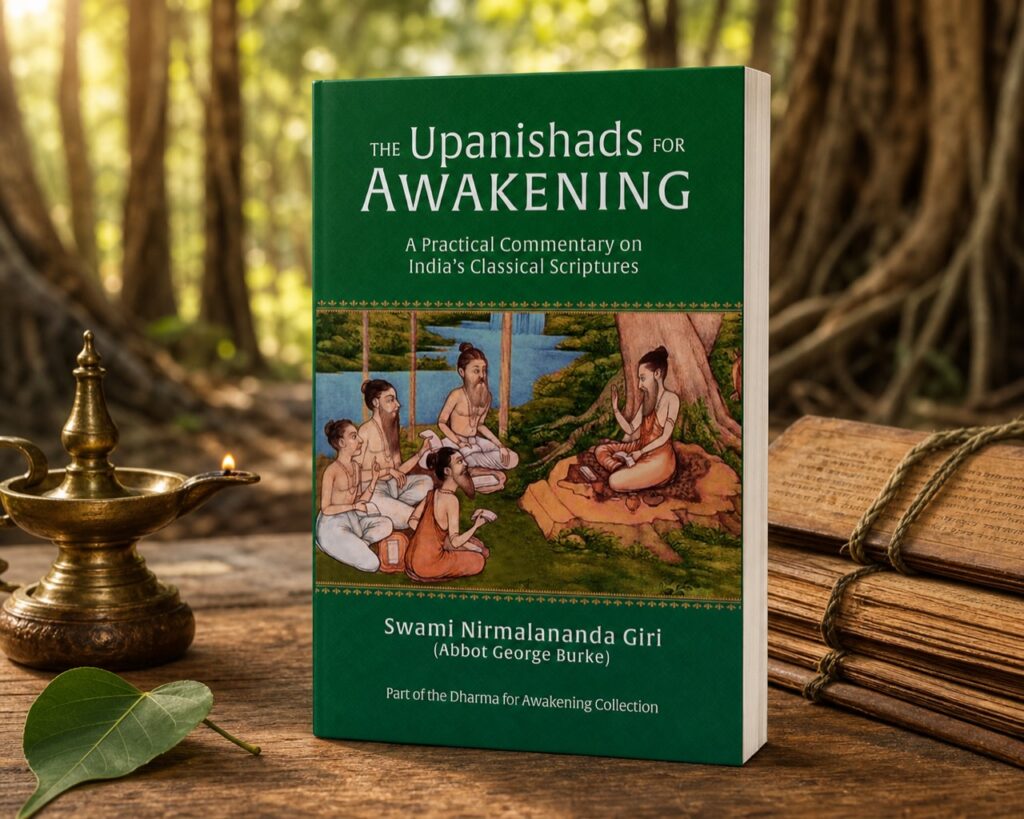
The Upanishadsfor Awakening
A Practical Commentary on India’s Classical Scriptures

The Upanishads stand at the fountainhead of India’s spiritual tradition. Composed by sages whose names have largely disappeared into antiquity, they turn again and again to the fundamental questions of spiritual life: What is the Self? What is Brahman, the Absolute Reality? What survives death? What is the nature of consciousness? And above all, how can these truths become matters of direct realization rather than belief?
In The Upanishads for Awakening, Swami Nirmalananda Giri approaches these ancient scriptures from the perspective of a practicing yogi. Drawing upon a lifetime of meditation, study, and experience in both Eastern and Western spiritual traditions, he takes up the principal Upanishadic passages concerned with Brahman, the Self, consciousness, karma, rebirth, meditation, and liberation, illuminating their meaning for the contemporary spiritual seeker.
The commentary continually returns to one essential principle: the truths of the Upanishads were never intended merely to furnish us with doctrines to believe. Their sages recorded what they had themselves perceived so that other seekers could press onward toward the same realization. As Swami Nirmalananda explains, their words are signposts by which the spiritual aspirant can test and deepen his or her own experience.
This practical orientation gives the book its distinctive character. Discussions of the nature of the Self lead naturally into meditation and the transformation of consciousness. Teachings about Brahman become teachings about our own deepest identity. Again and again, the reader is brought back from metaphysical speculation to the central purpose of the Upanishads: to awaken to the Self and know directly the Reality of which the sages speak.
A book to live with
Why Read This Book?
Enter the heart of India’s classical wisdom, exploring the Upanishadic teachings on Brahman, the Self, consciousness, karma, rebirth, meditation, and liberation.
Approach the Upanishads as a practicing spiritual seeker, not merely as a student of philosophy or comparative religion.
See how the great metaphysical teachings become practical, especially through meditation, Self-knowledge, and the transformation of consciousness.
Discover scripture as a guide to direct realization, following the sages’ invitation to experience for yourself the truths they recorded.

Experience the writing
From the Book
Featured excerpt
Scripture as Signpost, Not Dogma
To fully comprehend the teachings of the Upanishadic sages we must keep in mind that whatever can be said of the Paramatman on the cosmic, universal level can usually also be said of the jivatman on the level of our individual life within the cosmos. So the Upanishads do not only describe God, the Supreme Spirit, in passages like this, but the nature of our own individual spirit.
There is another, essential, side to this Upanishadic statement, and indeed to all scriptural teachings, that must be kept in mind at all times in our study: We must experience and know the realities spoken of by the sages. They did not write down their perceptions for us to merely accept them and be intellectually convinced of their veracity. Rather, they wrote them down as signposts so we could check our own perceptions against them. Never did they mean for their writings to become dogmas and doctrines. They assumed that their readers would be yogis like themselves, sadhaka pilgrims pressing on toward the ultimate frontiers of consciousness.
This is the absolutely unique character of the Upanishads and the Bhagavad Gita. Nearly all other scriptures, including those of later authorship in India, are statements of truths we are supposed to accept on faith without question. This is why intelligent investigation and analysis are so little valued by the expounders of those scriptures, why nearly all religions warn their adherents away from reading the books of “heretics” and demand that they shun their company. Intellectual fearlessness terrifies “the chosen faithful” and sets their teeth on edge.
But no religious system that employs a bond of any type can lead us to freedom, only confusion and enslavement. For example, in Yoga yama and niyama are not commandments from God but necessary and helpful supports to our search for Self-realization. Just as we learn what food is harmful to the body, so from Patanjali we learn what conduct limits and clouds the consciousness of the aspiring yogi. If we wish to ignore his counsel, that is our own concern. No one will call us to account for our heedlessness except our own Self.
Excerpt twoThe Self of Our Self+
In the beginning this (world) was only the Self [Atman], in the shape of a person. Looking around he saw nothing else than the Self. He first said, I am Soham [I am That]. (1.4.1)
Soham is the “first speaking” of the Absolute Itself: the expression of the knowledge and knowing of the Self. Soham is the Name (Embodiment) of the Primeval Being, the Self of the Universe and the Self of our Selfs. Soham is the Consciousness of Brahman and of the Self of each one of us. We, too, are Soham.
In the section of the Yoga Sutras (1:27) dealing with Ishwara, the Supreme Lord, also known as Viraj, Patanjali makes this statement: Tasya vachakah pranavah–“His vachaka is the pranava.” “Vachaka” means speech or speaking. “Pranava” means Life, Life-Giver and Breath Principle: the Breath Word. It is commonly thought of as Om, but integrating this with the verse we have been considering, we see that the Breath Word is Soham. For “he first said: ‘Soham.’” Patanjali continues regarding the Pranava: “Its constant repetition and meditation [is the way]. From it [result] the disappearance of obstacles [to enlightenment] and turning inward of consciousness” (1:28-29). Soham is the Breath and Life Word. Ishwara “speaks” Soham as the foundation of the universe, as the evolutionary life force within the cosmos and every individual being.
This is a key verse in the Upanishads, as it relates to both the philosophy of our true nature and the interior yogic process by which we realize it. We invoke our lower self when we say “I,” but in meditation we invoke our higher, divine Self when we mentally intone Soham in time with the breath: So when we inhale, and ham when we exhale. (See Soham Yoga: The Yoga of the Self regarding this as the means to Self-realization.) In the sixteenth verse of the Isha Upanishad it says: “I am that Purusha: I am Soham.”
Excerpt threeWe Need to Awaken+
The great teacher, Ajatashatru, was asked by a man named Gargya to teach him the truth about Brahman. Ajatashatru agrees, and this is what occurred:
Taking him [Gargya] by the hand he rose. The two together came to a person who was asleep. They addressed him with these names: Great, White-robed, Radiant Soma. The man did not get up. He woke him by rubbing him with his hand. He then got up. (2.1.15)
Occasionally in the Upanishads we find humor used to make a point, and this is one of them. Coming across a sleeping man, Ajatashatru addressed him as the divine Self: “Great, White–robed, Radiant Soma.” But it did no good, for the man was unconscious. It was pointless to address him at all. In the same way, all the positive affirming and philosophizing are worthless if the speaker and the hearers are spiritually asleep! Such sleepers do not need high-sounding words about the Self: they need to awaken. So Ajatashatru shook him until he woke up. We need to be shaken up, to awaken and see with our real eyes and hear with our real ears. Otherwise nothing meaningful will go on. The truth being spoken to us means nothing if we are not awake to hear it. Yoga is the great awakener. Other factors can disturb our sleep, get us to open our eyes a bit and then go back to sleep and just mumble and turn over and sleep on. But yoga alone fully awakens us. All the religion and piety mean absolutely nothing if we are not awake and clear in the mind.
Continue the journey
Continue Exploring
Companion books and approved resources for going further.