Dharma for Awakening
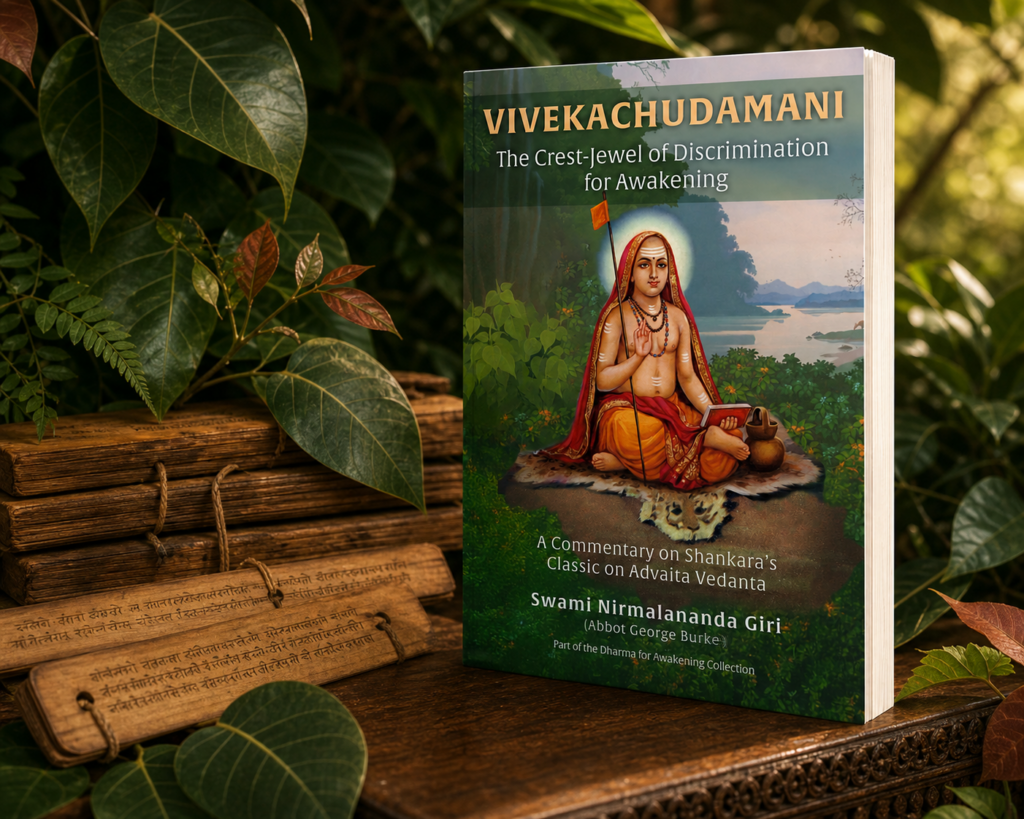
Vivekachudamani: The Crest-Jewel of Discriminationfor Awakening
A Commentary on Shankara’s Classic on Advaita Vedanta

Vivekachudamani–The Crest-Jewel of Discrimination–is one of the great classics of practical Advaita Vedanta: an uncompromising exploration of who we really are, what binds us to suffering and repeated birth, and how direct realization of the Self leads to liberation.
At the heart of the work is viveka–discrimination between the Real and the unreal, the Self and the non-Self, the permanent and the impermanent. Swami Nirmalananda Giri (Abbot George Burke) approaches this discrimination not as an abstract philosophical exercise but as an essential capacity that must be developed and realized through spiritual practice.
Working with Swami Madhavananda’s translation of the text attributed to Sri Adi Shankaracharya, the commentary proceeds verse by verse through such central teachings as the nature of the Atman, the five sheaths, the three gunas, maya and ignorance, vairagya or detachment, Self-knowledge, meditation, samadhi, and liberation.
Throughout the commentary, Swami Nirmalananda draws upon the Upanishads, Bhagavad Gita, the teachings of India’s great yogis, and his own decades of spiritual practice. He is particularly concerned with the difference between merely talking about non-duality and actually transforming consciousness through sadhana.
The result is a vigorous and practical guide to Advaita Vedanta for readers who want more than philosophical concepts. Vivekachudamani challenges the seeker to distinguish what is eternal from what passes away, to recognize the Self beneath the changing layers of body and mind, and ultimately to realize the truth directly rather than accepting it secondhand.
A book to live with
Why Read This Book?
Learn the practice of true discrimination by exploring viveka: the essential ability to distinguish the Real from the unreal, the Self from the non-Self, and the permanent from the impermanent.
Move from Vedantic theory to direct experience as the commentary distinguishes intellectual knowledge of non-duality from transformation through meditation, sadhana, and Self-realization.
Understand the inner structure of human consciousness through teachings on body, mind, ego, prana, the five koshas, the three gunas, maya, and the witnessing Atman.
Unite viveka with vairagya and spiritual practice, the two wings by which an aspirant rises toward liberation through sustained, living realization.

Experience the writing
From the Book
From the Book
The Flight of the Alone to the Alone
The aspirant to liberation asks: “How am I to cross this ocean of samsara? What means should I adopt? Tell me fully how to put an end to the misery of samsara.”
And in response the wise teacher replies:
1. A father has got his sons and others to free him from his debts, but he has got none but himself to remove his bondage.
The path to ultimate, Self-realization is truly “the flight of the alone to the Alone.” It is the path of one to the One. There is no one else involved. That is the truth. The individual (and this is never a group effort) who will succeed must possess within himself total self-motivation, total self-empowerment, total self-reliance and total self-effort. These qualities and abilities alone produce liberation.
Dependency is death for the yogi. Not even the greatest of sages can liberate the individual. The yogi is his own savior by revealing through his sadhana the truth, the reality, of his own ever-free, ever-illumined Atman-Self. The perfected yogi, the yoga siddha, is completely swayamprakash–self-illumined.
In matters of this earthly life we can have many helpers; but to remove all that binds us and to attain the ultimate freedom of kaivalya moksha is done by the yogi himself, and no other. Certainly he needs to learn the way to attain liberation from scriptures and genuine, worthy teachers, but from then on it is his effort alone that takes him to the goal. This must be understood by him from the very beginning.
From the BookWhat Are You Really?+
107. It is the foolish man who identifies himself with a mass of skin, flesh, fat, bones and filth, while the man of discrimination knows his own Self, the only Reality that there is, as distinct from the body.
This is all true!
108. The stupid man thinks he is the body, the book-learned man identifies himself with the mixture of body and mind, while the sage possessed of realization due to discrimination looks upon the eternal Atman as his Self, and thinks, “I am Brahman.”
Shankara does not mention the three gunas, but the three types of people he describes in ascending degrees correspond to tamas, rajas and sattwa gunas–the tamasic, rajasic and sattwic personalities.
The tamasic person–dull, mentally dark, intellectually inert, foolish and ignorant–thinks he is the material body alone. The rajasic person–active, emotional, restless of mind and therefore without completely calm and clear thought, even though intelligent–thinks he is mind and body combined. The sattwic person–illumined in intellect, pure in emotion, balanced in temperament, genuinely positive in character and aware of the reality of the Self as one with Brahman, though with distinction of degree, knows to say with a correct understanding: “I am Brahman.” In the Sanskrit text it is Brahmahamityeva, which completely means: “Who only thinks ‘I am Brahman.’” As the book of Proverbs (23:7) says: “As one thinks–so is he.”
109. O foolish person, cease to identify yourself with this bundle of skin, flesh, fat, bones and filth, and identify yourself instead with the Absolute Brahman, the Self of all, and thus attain to supreme Peace.
Easy to say!!! How will it be done? Only one way: “Therefore be a yogi” (Bhagavad Gita 6:46). Otherwise all “spirituality” is no more than a pipe-dream, a hallucination.
From the BookThe Two Wings of Liberation+
218. Know, O wise man, dispassion [vairagya] and discrimination [viveka] to be like the two wings of a bird in the case of an aspirant. Unless both are there, none can, with the help of either one, reach the creeper of liberation that grows, as it were, on the top of an edifice.
The two wings by which the yogi is enabled to fly in the sky of the Self are these:
1) Vairagya: Non-attachment; detachment; dispassion; absence of desire; disinterest; or indifference. Indifference towards and disgust for all worldly things and enjoyments.
2) Viveka: Discrimination between the Real and the unreal, between the Self and the non-Self, between the permanent and the impermanent; right intuitive discrimination.
They must be complete and they must be strong and constant.
Continue the journey
Continue Exploring
Companion books and approved resources for going further.