Hinduism & Sanatana Dharma
Hinduism: The Universal Religion
A Serious Student’s Guide to Sanatana Dharma

Hinduism: The Universal Religion is an advanced, systematic exploration of Sanatana Dharma for readers prepared to move beyond introductory accounts. It approaches the tradition as a comprehensive spiritual system concerned with humanity’s true goal and the course of evolution by which consciousness can move toward freedom.
The source work was published in Varanasi in 1920 by the Sri Bharat Dharma Mahamandal as The World’s Eternal Religion. Swami Nirmalananda Giri has newly edited it under the present title to distinguish it from LOSP’s separate Sanatana Dharma: The Eternal Religion and to make its dense traditional presentation more usable for contemporary students.
The book ranges across dharma and karma, worship and mantra, bhakti, the paths of action and knowledge, Hatha, Laya, and Raja Yoga, and the disciplines by which consciousness is purified. These subjects are presented not as disconnected customs or schools, but as parts of a universal spiritual system ordered toward the realization of humanity’s true nature.
Its philosophical and cosmological sections move through the gunas, Prakriti and Purusha, the planes of knowledge, creation and time, the visible and subtle worlds, spiritual evolution, and liberation. An extensive Sanskrit glossary is integral to the volume, giving the serious reader a working vocabulary for sustained study rather than casual browsing.
Readers already familiar with the basic language of Hinduism, yoga, or Vedanta will find here material for sustained study and reference. Those new to the subject may wish to begin with Sanatana Dharma: The Eternal Religion, the more foundational of these two independent and complementary historical works.
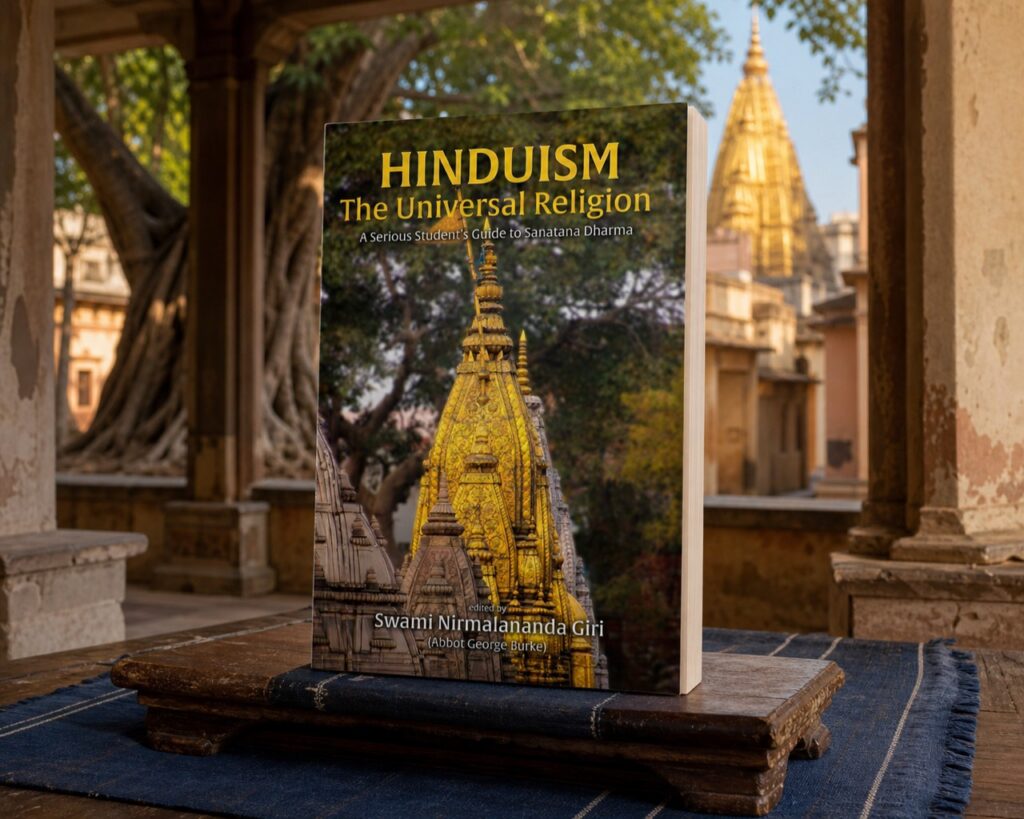
A book to live with
Why Read This Book?
Follow a deeper map of Sanatana Dharma through dharma, karma, spiritual evolution, the purpose of human life, and the relation of individual consciousness to cosmic reality.
Study the major paths and disciplines: worship, mantra, bhakti, karma, Hatha, Laya, and Raja Yoga, and the progressive purification of consciousness.
Enter its philosophical and cosmological framework through the gunas, Prakriti and Purusha, the planes of knowledge, creation, time, the worlds, and spiritual evolution.
Undertake sustained serious study with a dense traditional treatment and extensive Sanskrit glossary designed for readers prepared to study rather than merely browse.

Experience the writing
From the Book
PDF p. 4
A Universal Spiritual System
But the Indian Dharma, as will be seen from the following pages, is a universal spiritual system, recognizing the goal of humanity’s true life, and explaining and guiding its course to that goal. In this connection history and antiquarian research have little value. There is no reason why the teaching should not be accepted if it be in perfect agreement with science and philosophy, and capable of realization by positive experience in this life. This teaching comes by immemorial tradition from master to pupil and is recorded and preserved in part in the ancient Vedic literature, and in part in the more popular Puranas, Smritis and the like scriptural works, and extensive esoteric cults. The test of historical sequence and antiquarian research are no tests to prove the genuineness of such spiritual teachings. Even in their own province of utility, both these tests are condemned by their own critics, the one on account of the prejudices and ignorance of the original writers, the other on account of the vagueness of the authorities and the fancies of the interpreters.
PDF pp. 18–19Dharma for All Mankind+
On a careful examination of the foregoing, we see how deep was the insight of our rishis into dharmic action, and how wonderfully comprehensive are the divisions given! No religion of the world, living or dead, can possibly go outside the dharmas listed–all are included therein. We also find that differences in human nature, differences in temperaments and capacity, etc., have also been taken into account by the rishis. A person may, according to his taste, inclination and powers, choose any one of these angas of dharma, and if followed patiently, it will lead him to liberation. A tiny spark of fire may give birth to a big conflagration.
An emotional man will naturally choose the path of worship, a man having a liking for actions will choose the path of karma (action), and a contemplative man will choose the path of knowledge. But people are apt to forget that all paths lead to Him. We have no right to call people who follow a path different to ours, to be in the wrong. Sectarian antagonism and quarrel between religion and religion have absolutely no meaning.
To be all-comprehensive, and to apply to all mankind, a religion must prescribe different paths. It is so in Sanatana Dharma, where all, from the highest developed being who wishes to meditate on the formless Supreme Being down to the savage who worships the dark powers (asuras), the grossest fetishism and the highest absolutism, all have their place in the all-encompassing embrace of Sanatana Dharma.
PDF p. 69From Outward Search to Inner Knowledge+
Handicraft and industries characterize the first stage in the progress of a people. The next stage is that of advance in science. Discoveries and inventions are now made which conduce to material prosperity. Up to this time, the search is outward: the material world engrosses all attention and energy. Then a time comes when the search becomes inward. This is the beginning of Philosophy.
India had begun this inward search into the super-sensuous world long before any other nation had even dreamed of its existence. The wonderful truths (in comparison with which the truths of the material world discovered by science are but shadows), relating to the aforesaid subtle world discovered by the rishis of India have been arranged in seven systems, called the seven systems of Hindu Philosophy.
What will it avail a nation if it makes the greatest progress in arts, industries, science and so forth from the materialistic point of view, but none in the field of knowledge transcending all these? For material prosperity is not the be-all and the end-all of human life. What then is the goal, the aim and end of human existence? What is that, by obtaining which, we obtain everything? How to obtain this? The Jnana Kanda of the Vedas–the Hindu Philosophy–answers these questions.
As has already been indicated in the foreword, a human being has seven planes of wisdom (sapta–jnana–bhumi) in his spiritual career in life. He in his evolution towards perfection has to pass through them one-by-one. They are like the seven rungs of a ladder, helping the jiva to ascend to the Absolute One. As the jivatman passes one stage after another, the mind is more and more purified, he acquires more and more spiritual knowledge, until at last, when he has passed the last stage, his existence is merged in the One Eternal Blissful Existence. He attains nirvana, the happy goal!
Continue the journey
Continue Exploring
Companion books and approved resources for going further.