Original Christianity
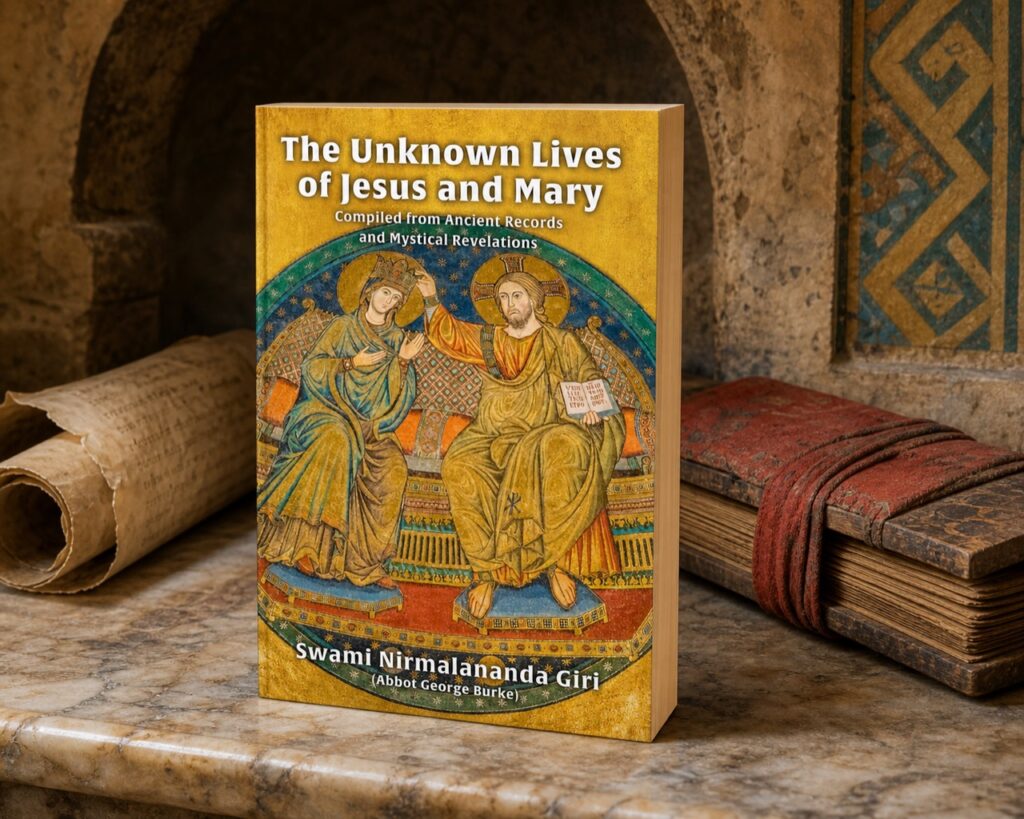
The Unknown Lives of Jesus and Mary
Compiled from Ancient Records and Mystical Revelations

The canonical Gospels tell only part of the story traditionally associated with Jesus and Mary. Early Christian communities preserved many additional writings concerning Mary and her family, the birth and infancy of Jesus, his youth, his Passion, and events connected with the first generations of Christian belief and devotion.
The Unknown Lives of Jesus and Mary gathers a substantial body of this little-known material from early Christian and apocryphal writings, traditional records, and mystical sources. Among the representative works are the Protoevangelium of Saint James, several infancy narratives, the Gospel of Nicodemus, the Ladakh manuscript concerning Jesus’ “Lost Years,” and the account of the falling asleep of Mary.
This is not merely an anthology. Swami Nirmalananda Giri introduces and comments upon the texts, drawing attention to their spiritual symbolism, their picture of early Christian belief and practice, and their relation to what he calls Original Christianity. His interpretive voice remains distinct from the source narratives, allowing the reader to encounter both the traditions themselves and the meanings he finds within them.
The book’s introduction also places these writings within the world of the early Church. Many works circulated among Christians beyond those eventually gathered into the New Testament, and exclusion from the canon did not necessarily mean that a text was considered spiritually worthless. These sources differ in kind and status—ancient or apocryphal writings, later traditions, historical claims, and mystical revelations—and are presented on their own terms rather than flattened into one assertion of established fact.
The larger purpose is not simply to fill gaps in sacred biography. Through these records and the commentary that accompanies them, the book offers a fuller sense of Jesus, Mary, and the spiritual imagination of early Christianity, inviting reflection on the inner meaning these traditions may hold for spiritual life.
A book to live with
Why Read This Book?
Explore little-known early Christian traditions concerning Mary, Jesus, their families, and events largely absent from the canonical Gospels.
Read ancient and apocryphal writings, traditional records, and mystical sources together with Swami Nirmalananda’s commentary.
Encounter accounts of Jesus’ infancy and “Lost Years,” the Passion and its aftermath, and the falling asleep of Mary.
See how these sources illuminate the broader spiritual world of early Christianity and the author’s understanding of Original Christianity.

Experience the writing
From the Book
Featured excerpt
Beyond the Canon
There are historical records of the lives of Jesus Christ and his Mother Mary that have been accepted and used by the Eastern Christian Church from Apostolic times and by the Western Church until the last few centuries. They were not included in the Holy Scriptures since it could not be established beyond doubt that they were written by one of the Twelve Apostles.
The first Christians did not at all consider the books which now make up the New Testament to be specially inspired in contrast to the books that were not included. In fact there was no New Testament at that time, just a collection of books by many authors. Many writings, such as those of Saint Ignatius of Antioch, a disciple of the Apostle John, were read in the churches as being inspired holy scripture. Excepting the Four Gospels, anything written by a saint today is considered by Eastern Christians to be virtually–though not officially–of the same value as the books of the Bible. But when a fundamental collection of authoritative Christian writings was to be made, it was decided that only those written by the Twelve should be included. However, the spiritual authority of other books was in no way lessened by this decision.
It is true, however, that the four Gospels of the New Testament are looked upon as having a unique value. This is because these four books are not mere history, but symbolic presentations of the passage from humanity to divinity, from son of man to Son of God. In the main the Gospels are historically true, but the choice and arrangement of incidents and teachings have an esoteric purpose, and the deeper meaning is to be sought beneath the surface appearance of things. The other gospels not included in the New Testament are simple history without this higher symbolic dimension. Yet they do contain a great deal of esoteric material, as we shall see.
Can we be sure these books are really historically accurate? Not any more than we can be sure of anything that comes to us from the past. However it would not matter if they were totally fiction, for since they were accepted and circulated by the Christians from the very beginning we can know that their contents were in perfect accord with the original principles of the Christian Church.
Excerpt twoMary in the Temple+
And he set her down upon the third step of the altar, and the Lord God sent grace upon her; and she danced with her feet and all the house of Israel loved her.
None but the priests ever came near the altar, much less went up on to the steps. By doing this Zachariah was affirming the divine priesthood (mediatorship) of the Virgin. Even now she remains in that position. The Virgin was placed on the third (top) step of the altar to show the supreme character of her priesthood. Inspired by God, she danced before God, as had David (II Samuel 6:14). This also showed the adult status of her mind.
Instead of being shocked at what would have normally been considered a defilement of the Temple, the people present rejoiced at the sight, and love for her arose in the hearts of the onlookers who had followed her into the Holy Place from which they, too, were usually barred. This incident foreshadows the Virgin’s mission to break all barriers and lead her children into the depths of holiness, making them priests and anointed of God.
All who saw her that day were captivated by the sight, because deep in their minds, in their inner consciousness, they knew who she was–that she was their Mother Eve come to deliver her children. (See Robe of Light.)
And her parents went down marveling, and praising the Lord God, because the child had not turned back. And Mary was in the Temple of the Lord as if she were a dove that dwelt there, and she received food from the hand of an angel.
Excerpt threeThe Ladakh Manuscript+
A generation later in 1922, Swami Abhedananda, a direct disciple of Sri Ramakrishna Paramhansa and Vice-President of the Ramakrishna Mission, went to the Himis monastery and asked to see the manuscript of which Notovich had written. (The Swami had seen and read the book earlier in America.) Because by that time the furor had long ago died down, and also because the Swami was obviously not a curiosity seeker or potential thief or vandal, one of the lamas showed him the manuscript–after assuring him that Notovich’s account of his visit and convalescence in the monastery was completely true. The lama further told the Swami that the manuscript he was showing him was a translation of the original which was kept in the library of the monastery of Marbour near Lhasa. The original text, the lama said, was in Pali, whereas the Himis manuscript was in Tibetan, consisting of fourteen chapters which contain a total of two hundred and twenty four verses. The lama, who knew English, read out some of the verses in English, demonstrating that Notovich’s translation was true and not a fabrication.