Dharma for Awakening
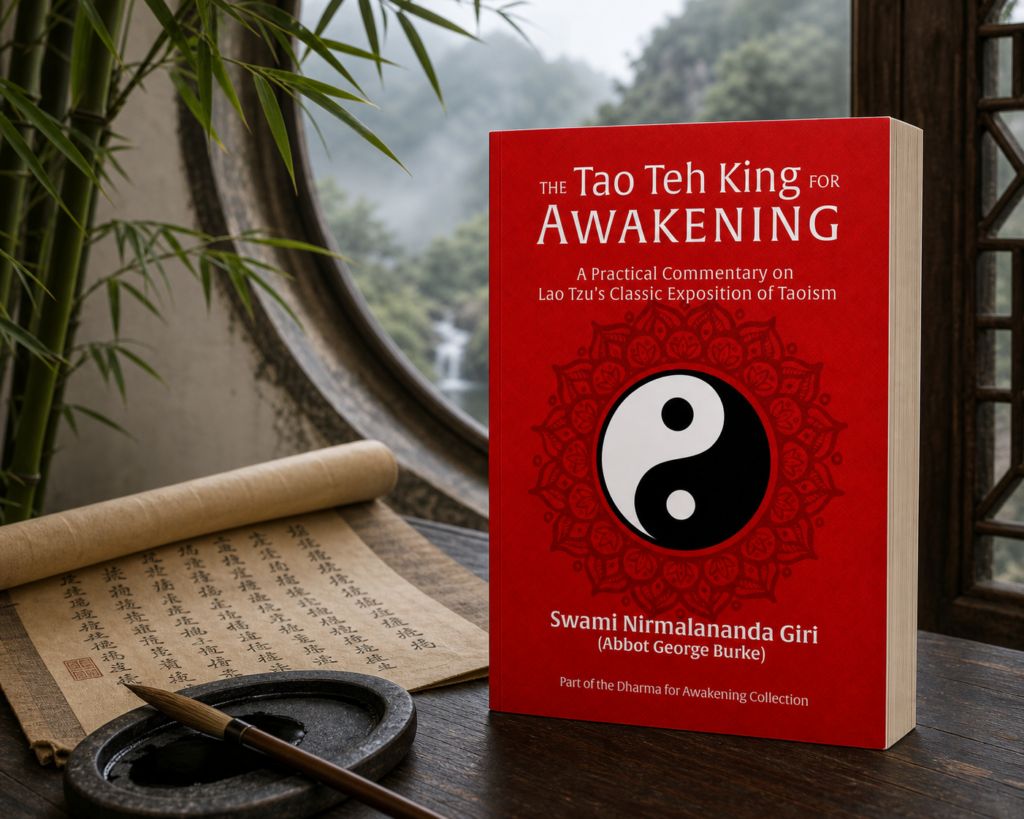
The Tao Teh Kingfor Awakening
A Practical Commentary on Lao Tzu’s Classic Exposition of Taoism

For more than two thousand years, the Tao Teh King–also known as the Tao Te Ching–has invited readers into a radically simple vision of reality: a Way beyond striving, possession, argument, and artificiality, yet expressed through the ordinary rhythms of nature and human life.
In The Tao Teh King for Awakening, Swami Nirmalananda Giri (Abbot George Burke) approaches Lao Tzu’s classic not primarily as an object of historical or scholarly study, but as a practical guide to spiritual realization. Chapter by chapter, he explores what the Tao means for a person seeking inner stillness, freedom from desire, simplicity, self-mastery, and conscious union with the ultimate Reality.
Swami Nirmalananda brings to the commentary a lifetime of immersion in both Eastern and Western spiritual traditions. Connections with the Upanishads, Bhagavad Gita, teachings of yoga, Christianity, Buddhism, and the lives of spiritual masters illuminate the striking universality of many of Lao Tzu’s insights without dissolving the distinctive character of Taoism.
Again and again the commentary returns philosophical paradox to spiritual practice: action without attachment, strength expressed through yielding, fullness discovered in emptiness, wisdom found in silence, and the movement of all things back toward their source.
The Tao Teh King for Awakening is therefore more than an explanation of an ancient text. It is an invitation to live differently: with less compulsion, less noise, greater inwardness, clearer perception, and deeper harmony with the eternal Way underlying both nature and the Self.
A book to live with
Why Read This Book?
Discover the Tao as a living spiritual way by moving beyond enigmatic sayings to practical guidance for awakening and inner transformation.
Learn the power of stillness, simplicity, and non-striving through Lao Tzu’s teaching on quietude, desirelessness, humility, flexibility, and action free from egoic compulsion.
See Eastern wisdom in a wider spiritual context through parallels with the Upanishads, Bhagavad Gita, yoga, Buddhism, Christianity, and spiritual masters while keeping Lao Tzu at the center.
Turn paradox into practice through action without deeds, strength through yielding, usefulness through emptiness, and returning to the root as principles to be lived.

Experience the writing
From the Book
From the Book
The Tao Beyond Names
The Tao that can be trodden is not the enduring and unchanging Tao. The name that can be named is not the enduring and unchanging name.
(Conceived of as) having no name, it is the Originator of heaven and earth; (conceived of as) having a name, it is the Mother of all things.
Always without desire we must be found,
If its deep mystery we would sound;
But if desire always within us be,
Its outer fringe is all that we shall see.
Under these two aspects, it is really the same; but as development takes place, it receives the different names. Together we call them the Mystery. Where the Mystery is the deepest is the gate of all that is subtle and wonderful.
(Tao Teh King 1)
The Tao that can be trodden is not the enduring and unchanging Tao. The name that can be named is not the enduring and unchanging name.
Like so many of the terms of virtually prehistoric Ancient Wisdom, “Tao” is not easy to translate; it may even be impossible to translate. The best we can do is say that “Tao” means Way. In fact, until the West started talking of “Buddhism” the path outlined by Sakyamuni Buddha was called “the Buddha Way” (Buddha Tao) in the orient. Because of the inseparability of Taoism and Chinese culture (which included philosophy and religion), Taoism flowed in the veins of Chinese Buddhism, however much Buddhist purists might have wished it otherwise. The existence of many Buddhist-Taoist temples in China and abroad make this clear.
What is the Way, the Tao? This opening verse might literally be rendered: “The Way that can be ‘wayed’ is not the Way.” That is, the way that can be traversed or travelled is not The Way that is the subject of this treatise. This may seem hopeless, but it is not that difficult to unravel. The Way is beyond any concept or experience of space and time. Therefore It cannot be thought of in those terms. In The Way we do not go from one point to another. Not even one step can be take on The Way because It does not exist in space. Similarly, we cannot think of “entering” the Way, because we are always “in” It. Nor can we think of time being spent experiencing or establishing ourselves in The Way, for It transcends time. The Way being utterly transcendent, nothing can be spoken that can convey Its nature or even Its existence.
Having no name, it is the Originator of heaven and earth; having a name, it is the Mother of all things. To say the Tao is One is not really accurate, for to our earthbound minds “one” means a single object; and the Tao can never be an object. We can speak of one apple, but not of one Tao. Yet here we see that a kind of duality or difference can be attributed to the Tao. Actually the duality is only in our own mind, but since we are attempting to at least hint at the truth about the Tao we have to “suspend belief” to do so. So from now on in this section the Tao will be spoken of inaccurately so we can get a somewhat accurate idea of It.
The Tao is both transcendent and immanent. In Its transcendent aspect “having no name” beyond all attributes, forms, or conditionings, It is the Source of heaven and earth, “of all things visible and invisible” as the Nicene Creed says. But in Its immanent aspect, “having a name,” It is the nurturing Mother of all things. That is, in Its active, dynamic side which produces the cosmos and evolves it to perfection, along with all those intelligences inhabiting forms within it, It is Mother of All.
Always without desire we must be found, if its deep mystery we would sound; but if desire always within us be, its outer fringe is all that we shall see. The Tao does all things, yet our interior disposition determines our success or failure in coming to knowledge of the unknowable Tao.
From the BookThe Wisdom of Water+
The highest excellence is like (that of) water. The excellence of water appears in its benefiting all things, and in its occupying, without striving (to the contrary), the low place which all men dislike. Hence (its way) is near to (that of) the Tao.
The excellence of a residence is in (the suitability of) the place; that of the mind is in abysmal stillness; that of associations is in their being with the virtuous; that of government is in its securing good order; that of (the conduct of) affairs is in its ability; and that of (the initiation of) any movement is in its timeliness.
And when (one with the highest excellence) does not wrangle (about his low position), no one finds fault with him.
(Tao Teh King 8)
The highest excellence is like (that of) water. The excellence of water appears in its benefiting all things, and in its occupying, without striving (to the contrary), the low place which all men dislike. Hence (its way) is near to (that of) the Tao. Once when someone asked Swami Brahmananda, the great disciple of Sri Ramakrishna, if he would bless him, the swami replied: “We have nothing to give but blessings,” referring to the superstitious idea held even today that sadhus have the power to curse as well as bless. The simile of a rose and a piece of sandalwood is often used in relation to truly good people: when crushed they only give forth their sweet fragrance. Without water nothing can live; in the same way the benevolence of the wise extends to every form of being.
From the BookReturn to the Root+
“Attain the utmost in Passivity, hold firm to the basis of Quietude. The myriad things take shape and rise to activity, but I watch them fall back to their repose. Like vegetation that luxuriantly grows but returns to the root (soil) from which it springs. To return to the root is Repose; it is called going back to one’s Destiny.
“Going back to one’s Destiny is to find the Eternal Law. To know the Eternal Law is Enlightenment. And not to know the Eternal Law is to court disaster. He who knows the Eternal Law is tolerant; being tolerant, he is impartial; being impartial, he is kingly; being kingly, he is in accord with Nature; being in accord with Nature, he is in accord with Tao; being in accord with Tao, he is eternal, and his whole life is preserved from harm.”
Attain the utmost in Passivity, hold firm to the basis of Quietude. The ideal of the Tao Teh King, the Bhagavad Gita and the teachings of Buddha are the same: we must transfer our awareness into the Stillpoint, the Silence that is the unmoving Consciousness which is our true Being. At the same time we must move through the world skillfully, so living as to end the compulsion to further rebirth. Meditation enables us to “attain the utmost in Passivity.” That is, it enables us to live centered in the unmoving Silence while being fully and effectively active. Through long practice of meditation we become able to “hold firm to the basis of Quietude” at all times.
The myriad things take shape and rise to activity, but I watch them fall back to their repose. Like vegetation that luxuriantly grows but returns to the root (soil) from which it springs.
Here we have another unanimity. All things arise into manifestation from the “primal soup” that consists of numberless elements that themselves are composites. Since coming implies going, and getting implies losing (for there is an inexorable impulse to ever return to the original state), it is inevitable that all things will return to non-manifestation, which Lao Tzu sees not as death or destruction, but a return to repose, to peace and freedom from the tension or stress inherent in all forms. There is a Root to all things: the Tao which is both Origin and Completion.
To return to the root is Repose; it is called going back to one’s Destiny. Total union/identity with the Tao is the only real destiny anything or anyone has. There is no real distinction between sentient and insentient being: all is Tao. And about That nothing can be said.
Going back to one’s Destiny is to find the Eternal Law. This is a perfect definition of Dharma: the return to the One. Anything that aids in this return is dharmic, and that which hinders the return is adharmic. This is the only basis upon which we should determine what is right or wrong, good or evil. Return is “the Eternal Law.”
To know the Eternal Law is Enlightenment. “Of the born, death is certain; of the dead, birth is certain” (Bhagavad Gita 2:27). Those who are born are without exception destined to die, so in a sense they are “dead” the moment they are born. In the same way, those that tread the way of the Eternal Law which ends in enlightenment are already enlightened by the fact of their pilgrimage. For this reason, those who walk the Way deserve our utmost respect, and those who persevere unto the end deserve our reverence and imitation.
And not to know the Eternal Law is to court disaster. That is so obvious it needs no comment.
He who knows the Eternal Law is tolerant; being tolerant, he is impartial; being impartial, he is kingly; being kingly, he is in accord with Nature; being in accord with Nature, he is in accord with Tao; being in accord with Tao, he is eternal, and his whole life is preserved from harm. Those who walk the Way advance in unfoldment of character step by step as outlined here until they are the Tao alone.
Continue the journey
Continue Exploring
Companion books and approved resources for going further.