Hinduism & Sanatana Dharma
The Inspired Wisdom of Lalla Yogeshwari
A Commentary on the Mystical Poetry of the Great Yogini of Kashmir

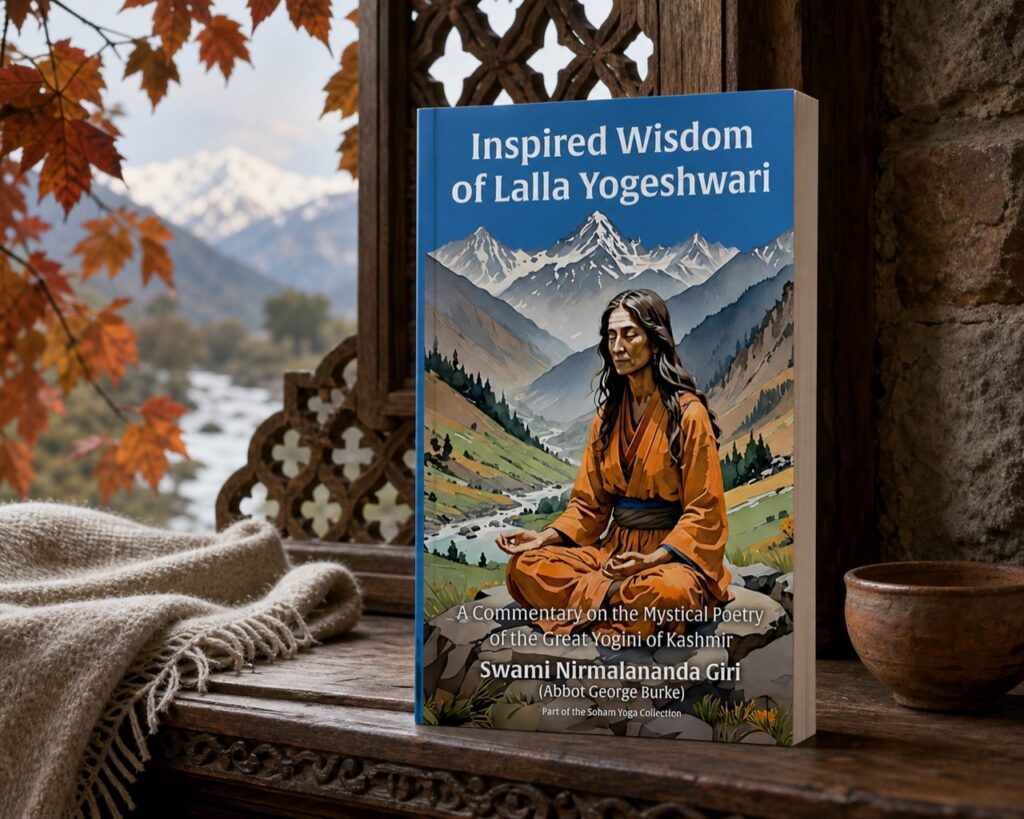
Lalla Yogeshwari—also known as Lalleshwari or Lal Ded—was a fourteenth-century Kashmiri yogini whose mystical verses, the Vakhs, are among the earliest known compositions in the Kashmiri language. Their directness has allowed her voice to remain vivid across the centuries: the voice of one who turned from outward convention toward the realization of the Self.
In The Inspired Wisdom of Lalla Yogeshwari, Swami Nirmalananda Giri reads the Vakhs not primarily as literary artifacts, but as the testimony and practical instruction of a realized yogini. Using the Jayalal Kaul text, he places Lalla within the Nath Yogi tradition and interprets her practice through Soham Sadhana—the inward joining of the mantra Soham with the natural breath.
The poems and commentary trace a recognizable spiritual progression: detachment from samsara and its illusions, discipline of mind and conduct, withdrawal of attention into the Inmost Self, and the gradual transformation of consciousness through meditation. Teachings on karma, discrimination, devotion, and liberation become aspects of one movement toward direct experience.
Swami Nirmalananda draws illuminating connections with the Bhagavad Gita, the Upanishadic and yogic traditions, Christian scripture, and his own experience of spiritual practice. The result is more than a collection of mystical poetry. It is a practitioner’s commentary that reveals the Vakhs as living instruction in Self-realization and the path by which Lalla came to declare that within and without, all was Light.
A book to live with
Why Read This Book?
Encounter the mystical Vakhs of Lalla Yogeshwari, one of Kashmir’s great yoginis and earliest poetic voices.
Understand her verses within the Nath Yogi tradition and the practice of Soham Sadhana joined to the natural breath.
Explore practical teachings on karma, detachment, mind, meditation, Self-knowledge, and liberation.
Follow Lalla’s spiritual testimony from struggle and discipline to direct realization of the Self and freedom from rebirth.

Experience the writing
From the Book
Featured excerpt
Withdraw Your Gaze Within
My Guru gave me but one percept:
“From without withdraw your gaze within
And fix it on the Inmost Self.”
Taking to heart this one percept,
Naked I began to dance.
In the Nath Yogi tradition God is the guru who is embodied in the Soham mantra. Lalla is relating to us what this Soham Guru directed her to do. The Gita says it very well: “Patiently, little by little, a man must free himself from all mental distractions, with the aid of the intelligent will. He must fix his mind upon the Atman, and never think of anything else” (Bhagavad Gita 6:25). He who follows this precept leaves all things behind and seeks the Self alone. “Naked” in his purpose and in the divesting of all other purpose or desire in his heart, he finds what he seeks and dances in his joyful freedom. “His mind is dead to the touch of the external: it is alive to the bliss of the Atman. Because his heart knows Brahman his happiness is for ever” (Bhagavad Gita 5:21). “When, through the practice of yoga, the mind ceases its restless movements, and becomes still, he realizes the Atman. It satisfies him entirely. Then he knows that infinite happiness which can be realized by the purified heart but is beyond the grasp of the senses. He stands firm in this realization. Because of it, he can never again wander from the inmost truth of his being” (Bhagavad Gita 6:20-21). “The abstinent run away from what they desire but carry their desires with them: when a man enters Reality, he leaves his desires behind him” (Bhagavad Gita 2:59). Blessed nudity!
Excerpt twoWithin and Without, All Was Light+
Gently, gently, I trained my mind to suspend its processes and thoughts.
Then (in the windless calm), the flame of the Lamp, shining steady and bright, revealed my true nature unto me.
In the dark recesses of my soul I seized upon Him and held Him fast.
Then I diffused the inner light, (and within, without, all was Light).
“Greater is he that is in you, than he that is in the world” (I John 4:4) is a cardinal principle of spiritual life. The entire world is formed of the ever-shifting energy patterns that comprise what is known as maya–cosmic illusion. But far greater than that is the consciousness that is the Self which is within us and is the essence of our very existence.
False yoga deals exclusively with “energy” and “operations of shakti.” This was very prevalent in the yoga boom of the nineteen sixties and seventies, since most of the people involved had a background in drug use. Consciousness was rarely mentioned–only vibration and energy–for their minds were still deeply marked by the damage and distortions resulting from drugs and “getting a buzz.” The false gurus also spoke in the same manner, since energy (shakti) is power, and “a natural high” was the ideal and offered result of meditation.
Therefore the practice of yoga was wrongly considered a matter of control of inner forces, or mastery of the mind (manas/buddhi) that was itself formed of energy. This was topped off by interest in awakening “kundalini shakti” and producing its various phenomena. Consequently many strenuous methods were advocated. I well remember an account of a supposed enlightened yogi who described his struggle in seizing the kundalini and pulling it upward from the base of his spine, and the way it often kept slipping from his mental grasp and dropping back down. Just hearing it exhausted me, but this is the way of illusion.
Lalla, however, was not deluded, but was a genuine yogini. So instead of engaging in a wrestling match with “the serpent power” gently she led her mind into the natural tranquility produced by Soham sadhana.
It is really important to keep in mind when Lalla writes of any yogic process that she was in the Nath Yogi tradition and practiced Soham sadhana: observing the natural, automatic breath and mentally intoning So throughout the inhalation and Hum [Ham] throughout the exhalation. When this is done while sitting with closed eyes and awareness of the breath and the inner intonations of Soham, that is meditation, and when it is done throughout the rest of the yogi’s waking day, that is japa (repetition).
When other types of yogic practices are engaged in, the effects are mostly completely different in their effect and experience from that of Soham sadhana. So when considering Lalla’s Vakhs this must be understood. What I will be writing here and later on when needed is completely according to the practice, effects and experiences produced by Soham Yoga.
Excerpt threeThe Lake of Immortal Bliss+
I, Lalla, entered by the garden-gate of mine own mind,
And there, O joy! saw Shiva with Shakti sealed in one;
And there itself I merged in the Lake of Immortal Bliss.
Now while alive I am unchained from the wheel of birth and death,
What can the world do unto me?
I, Lalla, entered by the garden-gate of mine own mind. This is an extremely important statement, for the Self is entered only through the gate of the mind. The mind itself is dual. It is both the manas, the sensory mind, and the buddhi, the intelligence–the intellect. In meditation the yogi joins these two in a union in which at first they reflect one another and then they absorb-assimilate one another.
And there, O joy! saw Shiva with Shakti sealed in one. Thus the union of Shiva and Shakti takes place on the level of the individual and on the level of the universal. Lalla realized her Self as Shiva and Shakti merged on these two levels.
And there itself I merged in the Lake of Immortal Bliss. In this manner she was merged in the perception of That Which Itself is Immortal Bliss (Ananda).
Now while alive I am unchained from the wheel of birth and death. What can the world do unto me? Although in the body, Lalla has become liberated from the cycle of birth and death. And therefore truly is no longer in the world, which as a consequence cannot even touch her in any manner or even be in any relation to her. She is truly a siddha-purusha, transcending all duality and dwelling totally in the state of Unity. This is absolute Fearlessness.
Continue the journey
Continue Exploring
Companion books and approved resources for going further.