Original Christianity
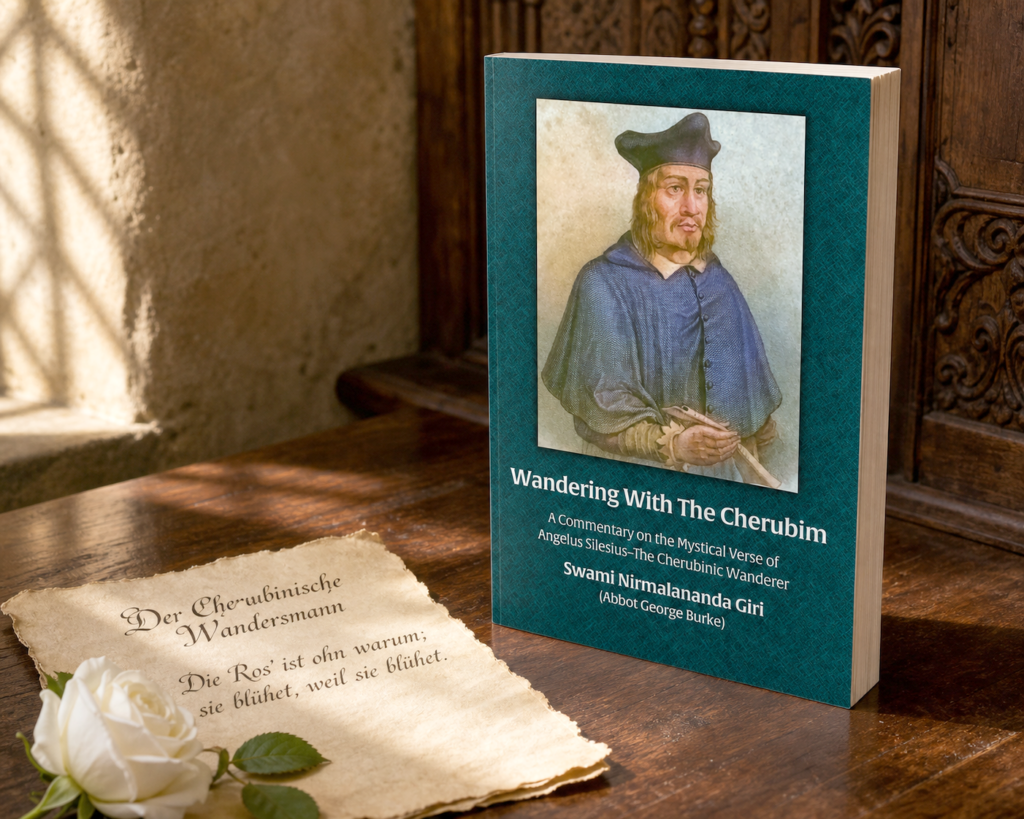
Wandering With the Cherubim
A Commentary on the Mystical Verse of Angelus Silesius–The Cherubinic Wanderer

The short mystical verses of Angelus Silesius possess an unusual power. Written in seventeenth-century Europe, they speak with startling directness about the soul, God, detachment, eternity, divine union, and the transcendence of the separate self.
Johannes Scheffler, known as Angelus Silesius, belongs to the great stream of Christian mysticism associated with Meister Eckhart, Johannes Tauler, Henry Suso, Jacob Boehme, and the spiritual worlds represented by Theologia Germanica and The Cloud of Unknowing. His compact poems often compress an entire spiritual teaching into only a few lines.
Many of the verses possess a strongly non-dual character. Their insights can therefore illuminate–and themselves be illuminated by–Advaita Vedanta and the universal search for direct realization of the Divine.
Swami Nirmalananda Giri approaches these verses as a lifelong spiritual practitioner rather than merely as literary or historical material. His commentary clarifies their inner meaning, draws connections with Christian mysticism, Vedanta, Advaita, and yoga where useful, and repeatedly returns the reader to the practical demands of spiritual life.
Wandering With the Cherubim is contemplative reading: a book to be read slowly, verse by verse, allowing the poems and commentary to become material for reflection, meditation, discrimination, detachment, and the awakening of direct spiritual understanding.
A book to live with
Why Read This Book?
Enter the concentrated mystical vision of Angelus Silesius through brief, penetrating verses on God, the soul, eternity, and divine union.
Explore the meeting points between Christian mysticism, non-duality, Advaita Vedanta, and the universal search for direct realization.
Go beyond intellectual interpretation through commentary grounded in spiritual practice, discrimination, and direct experience.
Use the verses as contemplative companions for meditation, reflection, detachment, and awakening to the Real.

Experience the writing
From the Book
Angelus Silesius · Commentary by Swami Nirmalananda Giri
The Absolute No-Thing
Angelus Silesius
God is an utter No-thingness,
Beyond the touch of Time and Place:
The more thou graspest after Him,
The more He fleeth thy embrace. (1.25)
Commentary
God is an utter No-thingness. We must never equate no-thing with nothing. God is the absolute No-thing. That is, he is not a relative, finite object that can be comprehended or known in an absolute sense. Our minds only know “things” even if they are non-material (such as thoughts and emotions) or even metaphysical. He is Reality and Being, but he is not in any sense a thing. All things exist in and because of him. He pervades all things and is one with all things, yet no thing contains him in the sense of encompassing or confining him.
Angelus Silesius · Commentary by Swami Nirmalananda GiriFreedom in the Spirit+
Angelus Silesius
Fetter me with a thousand chains,
And though they be
Never so strong,
I shall be fetterless and free. (1.118)
Commentary
This is because the true person, the spirit, cannot be chained by anything material, mental or spiritual. But the question then becomes: how do we become centered in the spirit and not dragged along by the vagaries of the mind and body? Though yoga meditation alone. Soham, “I am that,” is not just an idea, it is a realization attained through the faithful practice of Soham Yoga.
Angelus Silesius · Commentary by Swami Nirmalananda GiriThe Everlasting Now+
Angelus Silesius
Man, if thou findest Time
On earth drag on too slow.
Turn unto God–live in the
Everlasting Now. (4.200)
Commentary
Time and eternity are our perceptions, and not absolute realities as they are to God.
When we transfer our perceptions from time into eternity, the moment we reach perfection in consciousness, both disappear and we become them.
Continue the journey
Continue Exploring
Companion books and approved resources for going further.